Remembering Nandalal
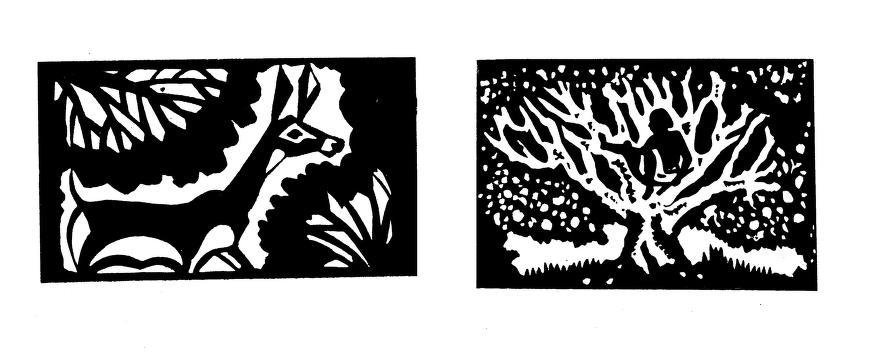
One of the works of art I carry around in my head is Sahaj Path, the classic Bangla primer written by Rabindranath Tagore and originally illustrated with woodcuts by Nandalal Bose.
I remember Sahaj Path as a work of art, not as a textbook. My mother, bringing us three brothers up in the (then) distant little town of Mt. Abu in the Aravalli hills of Rajasthan, all the way across the country from her hometown Calcutta, tried diligently to teach us to read and write Bangla with the aid of a copy of Sahaj Path. We all spoke the language reasonably well, but never progressed much as reading and writing was concerned.
But the magical black and white images from that book we used to pore over have never left my head. I remember them so vividly more than fifty years later … two boys huddling under a basket – the rain coming down in sheets around them, the farmer’s hut nestled in the deep shadow of a spreading tree, the leopard resting in a clearing at the water’s edge – calm, surrounded by birds and fish like in a vision of the garden of Eden, a fisherman perched on his boat peering at his own reflection in the inky depths, the row of trees on the edge of a paddy field (i could hear the wind whipping through them), those two creatures – perhaps dogs, perhaps jackals, sharing a moment – strangely intimate, strangely wild …
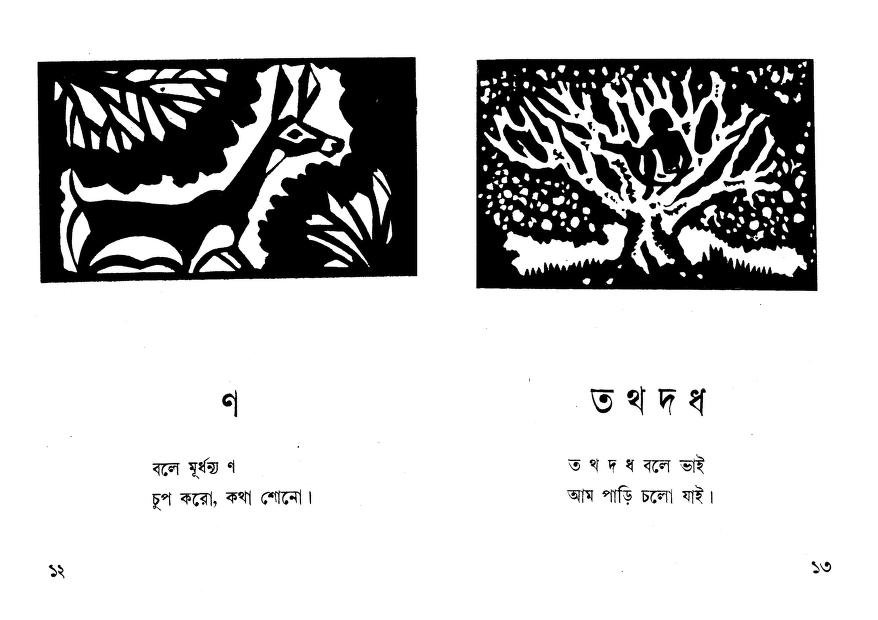
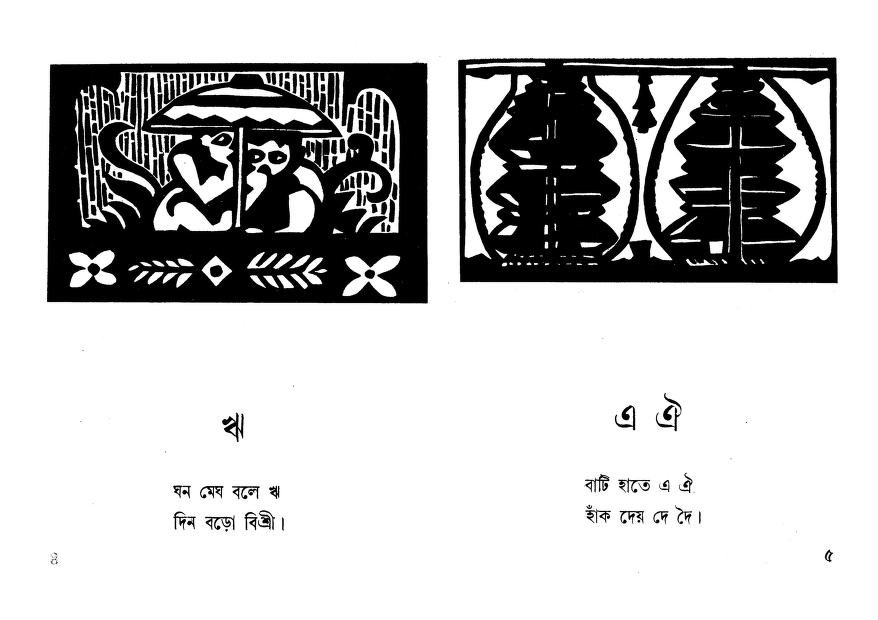
As a 4-year-old, I would leave the abstract world of letter forms, and enter the deep shadows and pale spaces of Nandalal’s wood-cut world. There, for the first time, I discovered the delights of shape, line and pattern and a fervent desire to draw. Soon, the exercise books meant to contain neat rows of letter-forms were being taken over by bold, unruly scrawls. After a while I think my mother gave up trying to seriously teach language, and allowed me to fill the pages with drawings even as we continued our lessons.
As I progressed on my drawing adventures, I started to become more proficient, and moved onto subjects such as cowboys and aeroplanes. But I would return to Sahaj Path every now and then till the book, much thumbed, finally disappeared from our lives at some point. Nandalal’s bold forms taught me something very valuable about how -and why- to combine an intensity of purpose with a playfulness of touch, sharp observation with a warm empathy for the subject, and the precision of craft with the ecstasy of inspiration.
Sudarshan’s Scissors
Along with favourite books and music, an assortment of odd and apparently non-functional objects have lived with me for years. They first made an appearance when my wife Gurpreet and I were living in a beautiful, crumbling old kothi in New Delhi’s Karol Bagh. Then they moved with us to another old house in Goa, and eventually travelled back northwards to become residents of our present Gurgaon apartment. Among them are a pair of tailor’s scissors made of teak wood. It is a beautiful object to hold. The sharp clefts and glittering edges of steel have been softened to warm brown wood, and sometimes I absentmindedly slip my fingers through its curved handles to cut random little pieces of paper. It’s very therapeutic.
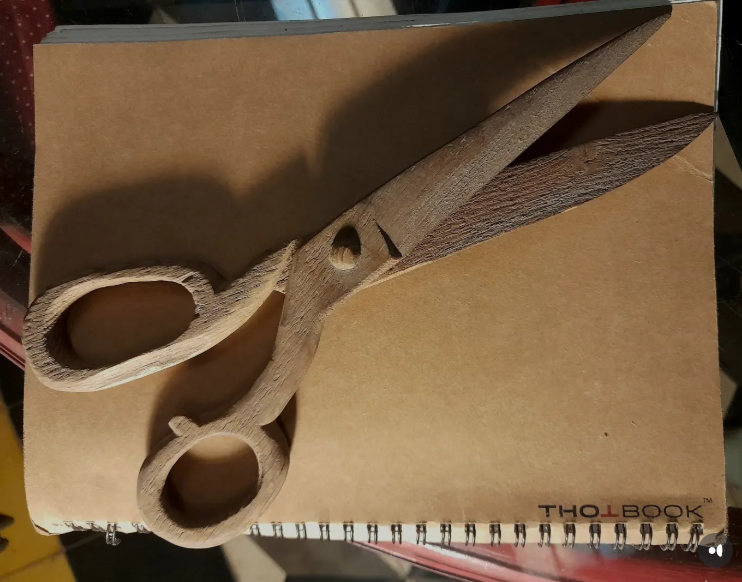
The scissors, along with a pink male torso neatly severed at the chest and thighs, and a pair of carved angel’s wings are the remnants of study pieces and discarded parts of Sudarshan Shetty’s first solo show ‘Paper Moon’, which opened at the Lalit Kala Akademi sometime in 1995. At that time, Sudarshan was working out of another old kothi nearby that belonged to mutual friend Dayanita Singh’s family, and we spent many hours being inspired and excited by each other’s ideas. Gurpreet and I had newly set up People Tree, and I was also working on my first graphic novel ‘River Of Stories’. Rahul Ram and other members of the (also newly formed) band Indian Ocean were frequent visitors, and we had a small but wonderful community of artists, filmmakers, social activists and musicians who hung out in these old houses, surrounded by the bustle and clatter of second-hand car dealerships, auto workshops and small businesses run by Punjabi migrants.
Snip – another little piece of the paper moon I’m shaping flutters down, catches a sudden breeze and floats out over the streets of Gurgaon. I fantasize it’s headed for Karol Bagh.
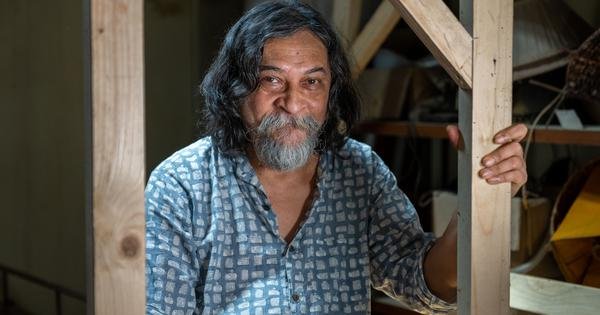
Authored by Orijit Sen
Orijit Sen is an Indian graphic artist, designer, muralist, artivist, and social documentarian. His expansive body of work includes murals, public art, comics, and graphic design, and has been extensively published, exhibited, and installed in India as well as internationally. His groundbreaking River of Stories (1994), considered the country’s first graphic novel, laid the foundation for India’s contemporary comics culture. He co-founded People Tree in 1990 as a collaborative studio and store for artists, designers, and craftspeople.