
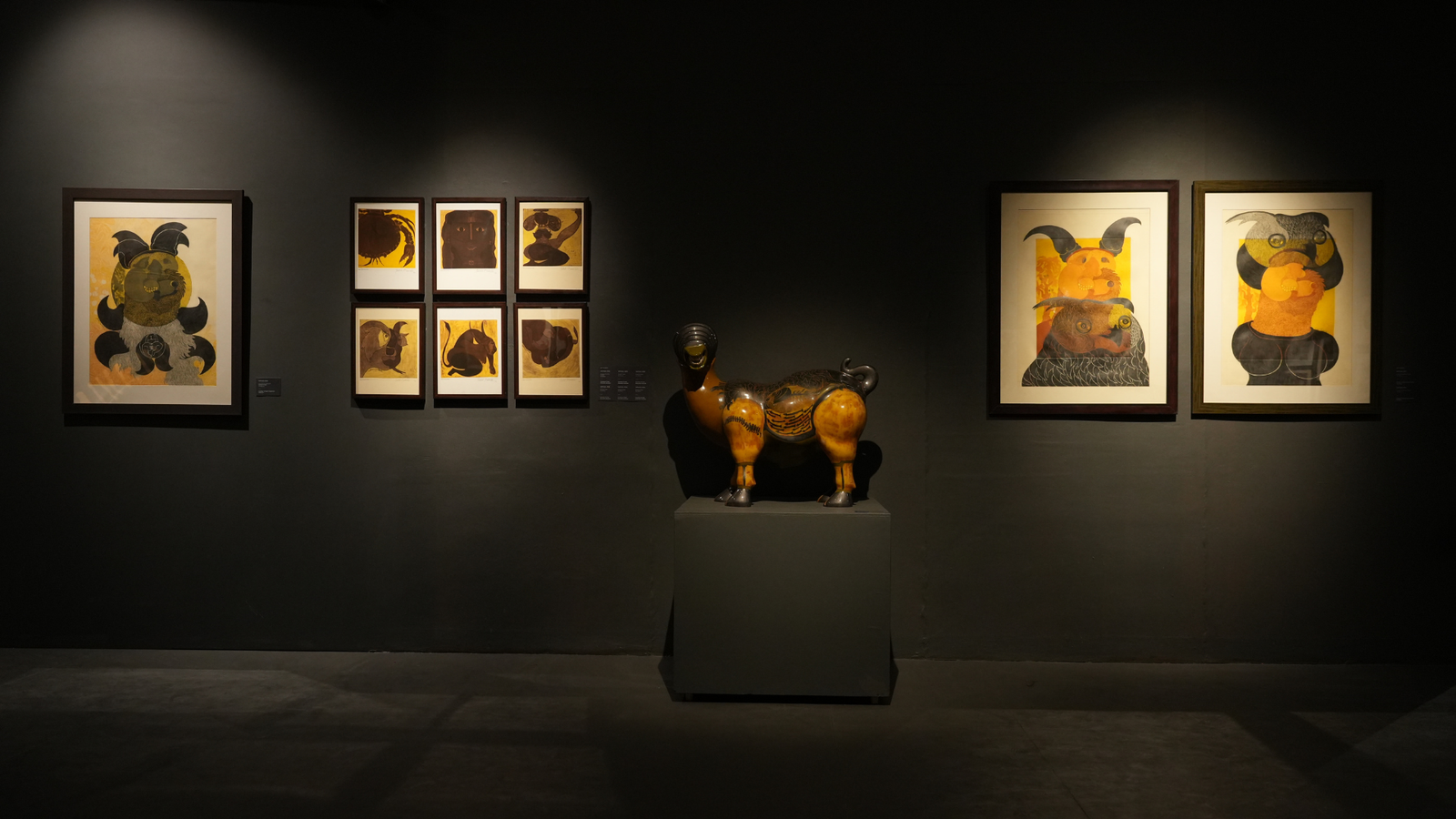
The recent exhibition My Many Worlds: A Santosh Morajkar Retrospective brings together works spanning 1997 to 2025 by an artist who was unafraid, bold, and loved to challenge and bait his audience into conversations that may not always have been comfortable with. It is no surprise that Santosh is also often remembered as the life of the party, the man with a joke, and someone who was capable of not only shaking off his own inhibitions, but also pushing you to shake off yours.
Santosh’s enduring legacy lies, of course, in his brilliant artworks, which continue to stand on their own even when he is no longer here. But it also lies in his words, jokes, and provocations to be a little more adventurous and unapologetic in our own lives. His students, mentors, colleagues, and family remember him as someone who pushed people to be more themselves, and to be daring in doing so. It is only right, then, that when the Museum of Goa brought his work together in a retrospective, we gave his boldness the space and room it deserved. His erotic forms did not ask for our permission to be seen, and in the process, perhaps liberated our minds to consider what else we might allow ourselves to encounter in public spaces.
This essay takes the exhibition and Santosh’s art as a starting point to ask why we, as a society, are so scandalised by the human body that its very visibility makes us uncomfortable. By making the so-called ‘obscene’ visible, his work invites us to turn the question inward and examine why we see things the way we do.
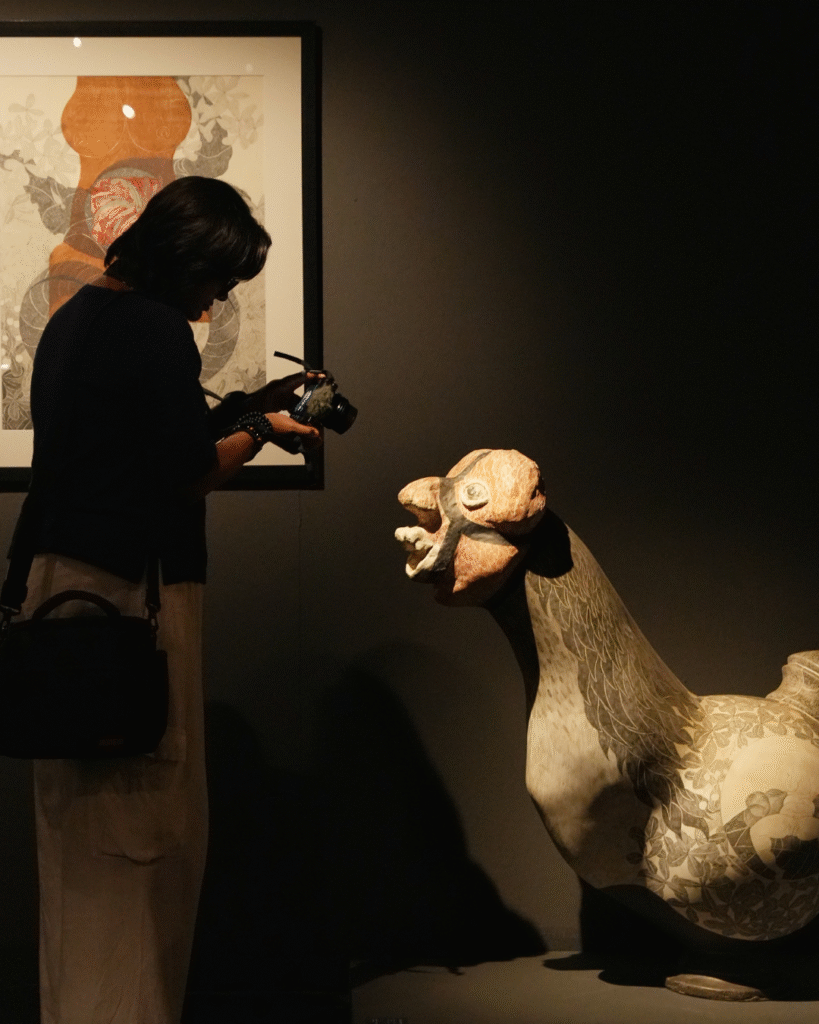
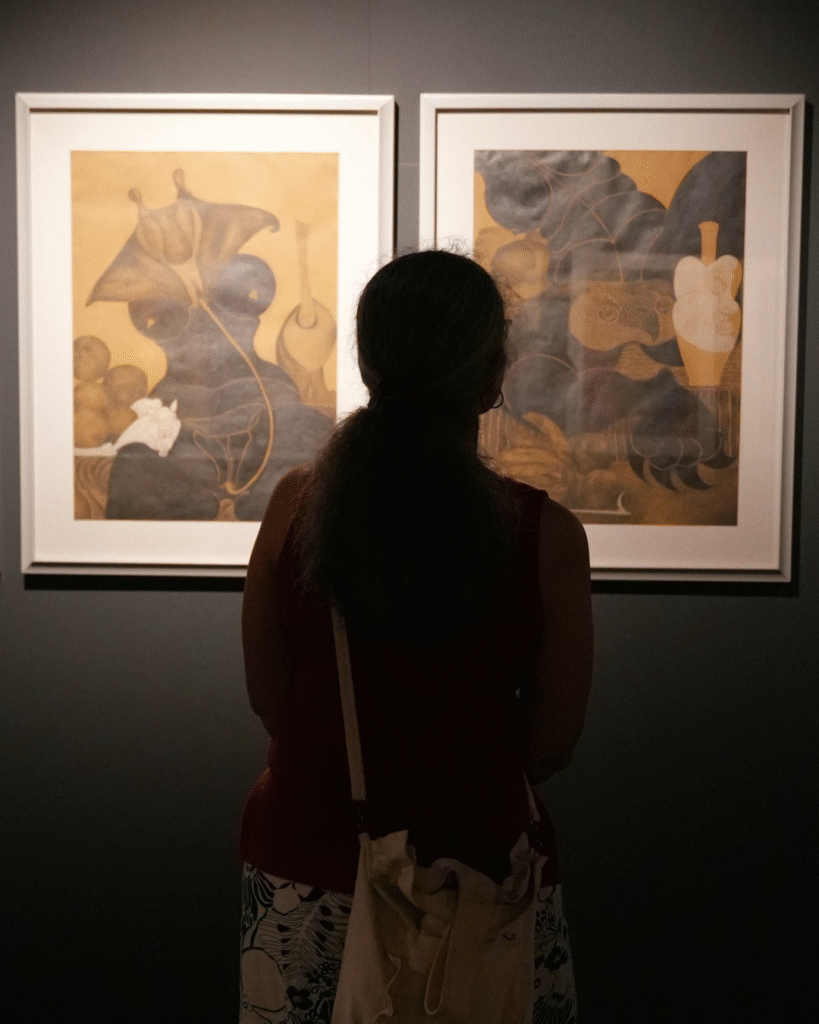
The body is not inherently obscene. We have learnt to read it that way.
Shatter the glass ceiling, and perhaps the ground you have been standing on, too. This is the premise we enter into when we begin this conversation. The problem with nudity or erotic art in public spaces lies, in part, in two things: the gaze of the creator and the gaze of the viewer. What does the artist choose to show us, and how do we choose to look at it? Both shape the encounter, although neither exists in isolation from the social and cultural worlds that have taught us what to see, what to desire, and what to find shameful.
The problem, then, is not simply that the naked or erotic body is censored. It is that we have learnt to look at the body through a narrow set of meanings, in which visibility becomes sexualisation, and sexualisation becomes grounds for shame or control.
Art historian and critic John Berger, in Ways of Seeing (1972), examines how looking is never entirely innocent. He writes about the ways women, particularly in European visual traditions, have been represented as objects to be looked at, while men occupy the position of the viewer. Laura Mulvey’s influential essay Visual Pleasure and Narrative Cinema (1975) develops a related argument through film, examining how visual pleasure can be organised around a gendered gaze. While both thinkers are writing in specific contexts, their work offers a useful starting point for asking how bodies become objects of looking, and how certain ways of looking come to feel natural to us.
So what happens when the body refuses to cooperate with this gaze?
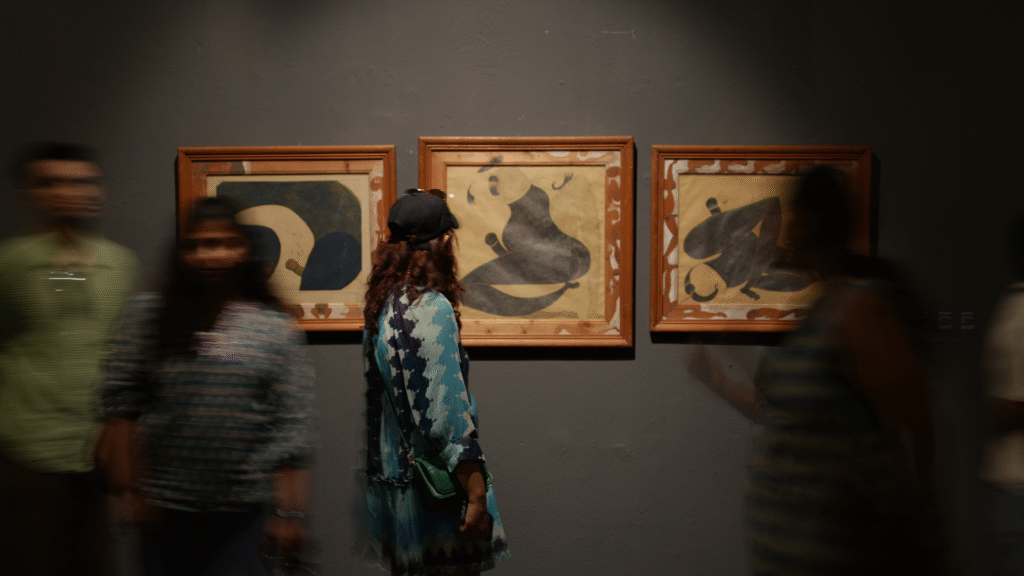
What Morajkar does is particularly interesting here because his bodily forms do not always invite the viewer into a familiar relationship with sexuality or desire. They are allowed to be grotesque, playful, strange, humorous, and vulnerable. Sometimes, they are simply shapes he is confident enough to draw, again and again, without the need to justify their existence. The viewer encounters bodies that do not fit neatly into familiar categories of beauty, modesty, masculinity, femininity, or sexual desirability.
He has phalluses turning into tiny creatures running around the frames. He adds claws to a glorious female nude. A manta ray emerges from a vagina, while phallic forms turn into the most adorable lizards. There is something so distinctly Santosh about this disposition. He is probably laughing at all of us. Perhaps he knows that the moment we encounter these forms, we begin the work of categorising them, deciding what they are, what they mean, and whether we should be looking at them at all.
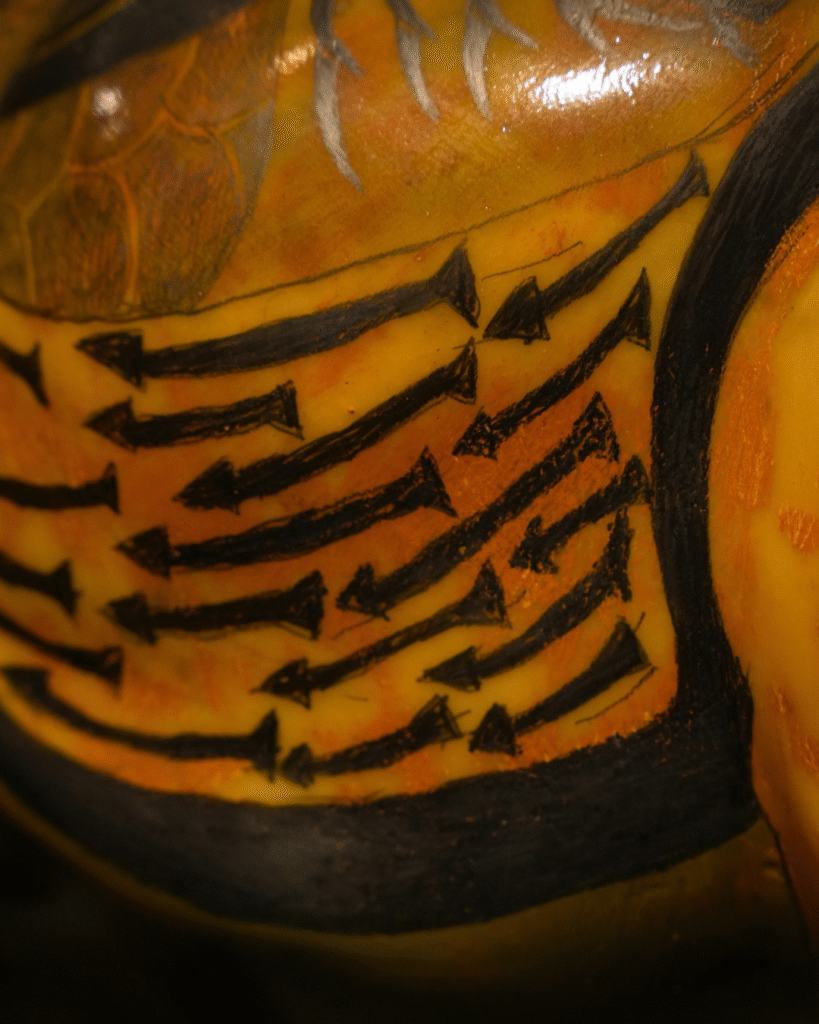
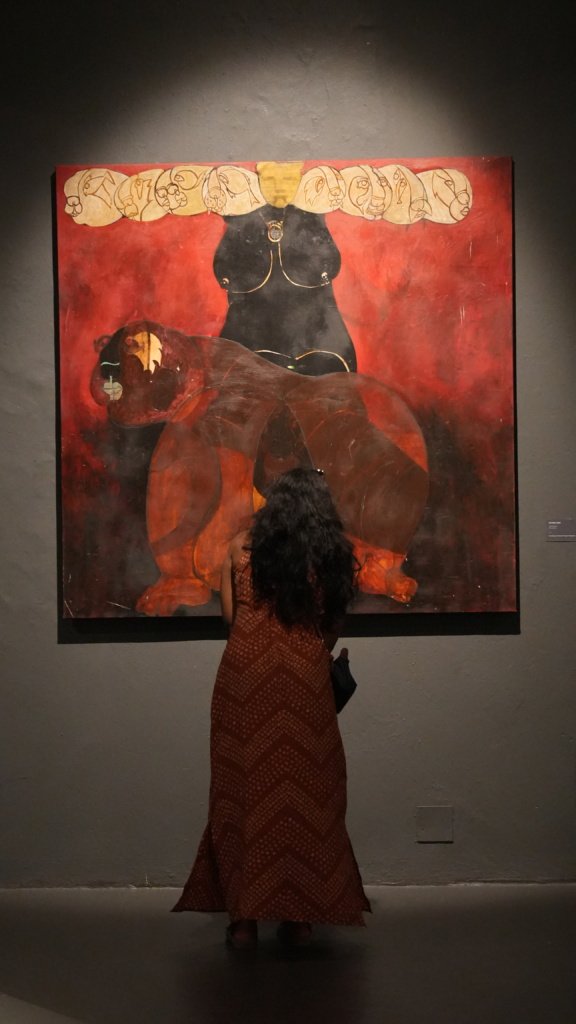
The humour is important here. These forms do not necessarily ask to be interpreted through the seriousness with which we often approach sexuality. They are strange, sometimes absurd, and difficult to make sense of. They disrupt the certainty with which we assign meaning to the body. We might arrive at the work expecting to see something erotic, only to find ourselves laughing at a creature, wondering about its anatomy, or simply appreciating the artist’s imagination. The body here moves beyond its presumed purpose as an object of desire.
This does not mean that the works have no erotic meaning, or that every viewer will experience them in the same way. They simply make room for other possibilities.
Perhaps this is where we might begin to question our understanding of obscenity. In her research on the politics of the nude in nineteenth-century India, art historian Niharika Dinkar examines how colonial-era art education and European ideas about the naked body shaped Indian pictorial traditions. Her work complicates the assumption that the nude is simply a natural body without clothes, arguing instead that ideas about nakedness, adornment and the erotic are themselves historically constructed. The body does not enter the public realm with a fixed meaning. The ways in which it is represented, viewed and understood are shaped by particular histories and cultural expectations.
The legal history of obscenity in India offers another way to understand this. In the 1964 Supreme Court case Ranjit D. Udeshi v. State of Maharashtra, which concerned the publication of D. H. Lawrence’s Lady Chatterley’s Lover, the Court acknowledged that the mere treatment of sex and nudity in art and literature could not, by itself, establish obscenity. Yet the case also illustrates how the boundaries between art, sexuality and public morality have been negotiated through legal and social judgements.
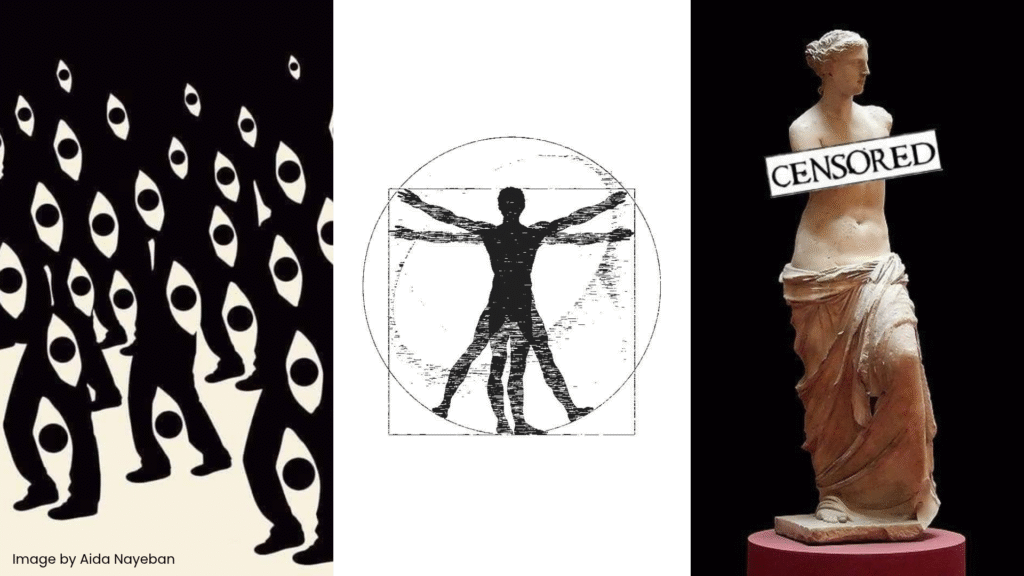
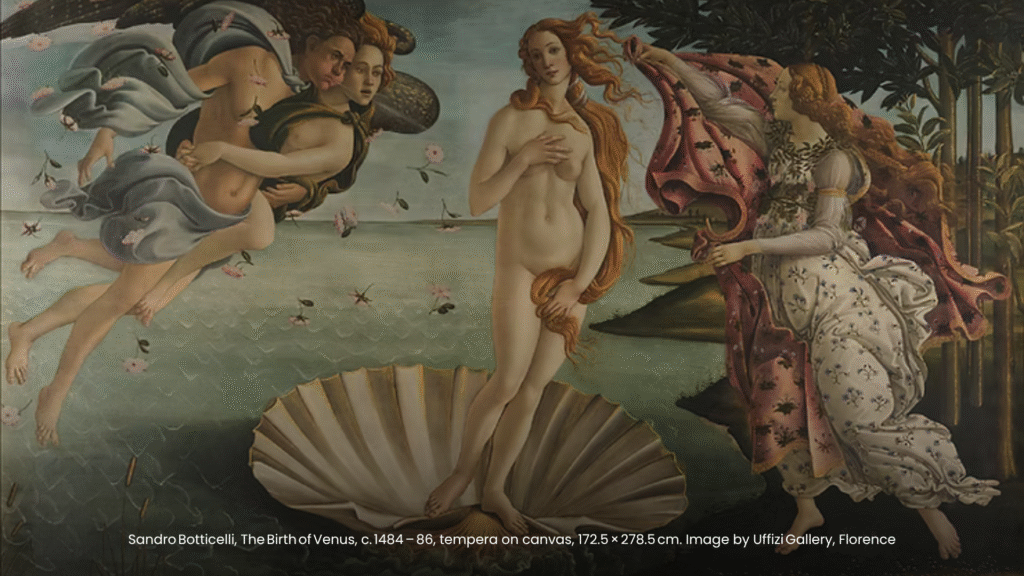
Before we arrive at an answer, we must ask ourselves a few more questions. Why do certain bodily forms provoke discomfort even when they are not presented in a sexual context? What makes a breast, a pair of buttocks, a genital form, or a naked figure suddenly inappropriate in public? Why are some bodies accepted in medical diagrams, religious imagery, or classical sculpture, but become controversial when they appear in contemporary art? And why do we so often look for a justification for the presence of the body, as though it must earn the right to be seen?
But in questioning the obscene, we must be careful not to create another category of the unacceptable. There is nothing inherently wrong with art that is sexual, sensual or deliberately erotic. Desire, pleasure and sexuality are as much a part of human experience as humour, grief or vulnerability, and art has every right to explore them. To suggest that an artwork must be non-sexual to be worthy of public display would be to impose another form of censorship. The question here is not whether art should be allowed to be erotic, but why we are so quick to treat the erotic as obscene in the first place. To understand that distinction, we must first ask what we mean when we call something obscene, and what we think we are protecting when we do. But most importantly, who taught us to look and think this way?
The Postcolonial Indian Gaze: Shame, Morality and Control
How did certain representations of the body become acceptable, while others came to be seen as vulgar, indecent, or dangerous? And how much of what we consider our own ideas of morality has been inherited from histories we have not fully examined?
The postcolonial Indian gaze is an interesting place to begin looking for answers. The word postcolonial here does not simply refer to the period after India gained independence in 1947. It also asks us to consider how colonial systems of knowledge (which also influence upper-caste Indian thinking), morality, and social regulation continue to shape the ways we understand ourselves, our bodies, and our relationship with public life.
The Victorian era changed how sexuality and the body were understood in India, but it did not introduce shame into Indian society for the first time. Pre-colonial Indian traditions had their own ideas of modesty, sexual conduct and social propriety, shaped by caste, gender, community and religious practice. These ideas were not uniform. In some Hindu traditions, the body and erotic desire also had a place in religious and artistic life. The Kama Sutra, temple sculptures, and other forms of visual culture remind us that sexuality was not always treated as something that had to be hidden. This does not mean pre-colonial India was free of sexual restrictions; rather, shame and modesty operated within different cultural and social frameworks.
Under British rule, Victorian ideas of sexual respectability became codified and increasingly influential through education, administration, law and public morality. The colonial state classified and regulated sexual behaviour, while Indian social and religious reform movements also developed their own responses to these ideas. Over time, certain forms of respectability came to be associated with a modern, respectable Indian identity. This was not simply a case of the British imposing their morality on a passive society: colonial values interacted with existing hierarchies and local reform movements, reshaping how bodies and sexuality were discussed and regulated.
This shift was also written into law. Section 292 of the Indian Penal Code, introduced under British rule, criminalised the circulation of material deemed obscene, while leaving the meaning of obscenity open to interpretation. After independence, the law remained, and Indian courts continued to decide where artistic expression ended, and obscenity began. As legal scholar Latika Vashist argues, these judgements have often relied on disgust towards sexuality and fears of transgressive sexual behaviour.
Discomfort, then, becomes a means of control. When a body makes someone uncomfortable, that discomfort can be presented as evidence that the body itself is wrong, immoral or dangerous. The question shifts from ‘Why does this make me uncomfortable?’ to ‘Why should this be allowed to exist?’ In this way, personal discomfort becomes a claim over public space: it can be used to decide what others may see, express, or create. It also allows social norms to police bodies without requiring a clear account of the harm being caused.
For contemporary art, this matters because the same body can be accepted in one context and condemned in another. A nude figure in a temple or classical artwork may be protected by tradition, while a contemporary artist’s erotic form is labelled obscene. The issue is not simply the presence of the body, but who is allowed to represent it, in what context, and according to whose standards of respectability.
The Responsibility of Looking
It would be naïve to assume that displaying the human body in a public space is, in itself, a challenge to the ways we have learnt to look at it. A body in a gallery can still be objectified. A nude figure can still be viewed through a heterosexual, gendered or voyeuristic gaze. The museum does not automatically make an artwork innocent of these dynamics, nor does artistic intention determine how a viewer will interpret it. The body can be made visible and still be reduced to the very meanings we might hope to move beyond.
Yet visibility can also create the conditions for a different relationship with the body. It can allow people to encounter forms they have been taught to hide, fear, or judge, and to sit with the discomfort these encounters might produce. Over time, such encounters can expand what feels ordinary, discussable, and acceptable. This does not mean that repeated exposure will necessarily change how we look, or that every representation is liberating. It means that public spaces can offer opportunities to question the assumptions we bring to what we see.
The purpose, then, is not to desexualise every body, or to suggest that sexuality has no place in art. It is to make room for meanings beyond sexual desire, while acknowledging that eroticism, sensuality and pleasure are valid subjects in their own right. More importantly, it is to encourage viewers to examine their responses rather than mistake them for universal truths. What makes us uncomfortable? Where does that discomfort come from? And should it determine what others are allowed to create and encounter?
This brings us to a question that matters as much for artists as it does for the institutions that exhibit their work: what does it mean to make space for the body responsibly, without making it less bold, less challenging or less free? Contemporary artists, curators and art practitioners cannot control every interpretation of an artwork, nor should they have to make work that is comfortable for everyone. But they can create spaces in which difficult forms and ideas are allowed to exist, where viewers are invited to question their assumptions, and where discomfort does not automatically become a reason for exclusion.
The Role of Artists, Curators and Museum Spaces
Artists, curators and museums are not simply observers of culture. They are part of the spaces in which culture is made, encountered and understood. Artists introduce forms and ideas into the world, sometimes without knowing all the meanings they might come to hold. Curators create the frameworks through which these works are encountered, while museums decide what enters public space, how it is presented and which conversations are given room to unfold. These are not and cannot be neutral acts.
This brings with it a responsibility. Does a museum have a responsibility to make difficult or uncomfortable work visible? Should the possibility of offence determine whether an artwork is exhibited? And how do we create space for disagreement without treating discomfort as a reason to withdraw a work or close down a conversation? There are no easy answers, but these are questions art institutions must be willing to ask themselves. Context can help viewers engage with a work, but it should not become a set of instructions that determines what they are allowed to think or feel about it. Equally, making a work visible does not mean placing it beyond criticism. The responsibility of an art space is not to tell its audience what to feel, but to create the conditions in which looking, questioning, and disagreement can take place.
So much of our engagement with art today turns towards memory, loss and grief. These are necessary subjects, particularly in a world where histories are erased, communities displaced and ways of life threatened. But are these the only experiences through which we want to understand ourselves? What happens to pleasure, desire, humour, absurdity, the body and the freedom to be unapologetically alive? What space do we make for art that does not ask us to remember or mourn, but instead challenges us to look differently, to laugh, to feel desire, or simply to encounter something we do not yet know how to name?
This is not an argument against art about memory or grief. It is an argument for allowing our cultural conversations to be as expansive as the lives we lead. If museums are spaces where we encounter the world and our place within it, they must make room for the full range of human experience, including the parts that remain awkward, uncomfortable or difficult to categorise. We cannot claim to be open to complexity while permitting only certain kinds of complexity to enter our galleries.
Perhaps this is what makes Santosh Morajkar’s work so important to revisit. His creatures, erotic forms, and playful distortions do not always offer us a clear lesson or a comfortable narrative. They ask us to look, to react, and perhaps to catch ourselves in the act of deciding what is acceptable to see. There is a certain freedom in that encounter: the freedom to let a form exist without immediately correcting it, explaining it away, or demanding that it justify its presence.
Conclusion
The question we must leave with is not whether the body belongs in public, but why we continue to believe that its presence needs to be justified. Asking this pushes us to remember that we must make room for pleasure as much as grief, for desire as much as memory, and for the unfamiliar without immediately asking it to explain itself. The freedom to look differently begins with allowing ourselves to see what we have been taught to look away from.
Authored by Ahasthya A., Curatorial Associate, Museum of Goa
References
Berger, J. (1972). Ways of seeing. Penguin Books.
Dinkar, N. (2019). Empires of light: Vision, visibility and power in colonial India. Manchester University Press. https://doi.org/10.7765/9781526139641
Empires of light+1
India. (1860). The Indian Penal Code, 1860 (Act No. 45 of 1860), § 292.
IndiaCode
Mulvey, L. (1975). Visual pleasure and narrative cinema. Screen, 16(3), 6–18. https://doi.org/10.1093/screen/16.3.6
Oxford Academic
Ranjit D. Udeshi v. State of Maharashtra, AIR 1965 SC 881 (India).
Indian Kanoon
Vātsyāyana. (2002). Kamasutra (W. Doniger & S. Kakar, Trans.). Oxford University Press.
Vashist, L. (2022). Disgust for the sexual: The emotional side of obscenity law in India. Oxford University Commonwealth Law Journal, 22(2), 150–176. https://doi.org/10.1080/14729342.2022.2146946