
Oral History, as the world understands it, is “the collection and study of historical information using sound recordings of interviews with people who remember past events.
Oral history can be roughly divided up into three or four categories: life histories, topical histories, thematic studies and site or artefact specific research. Now, by its very definition, oral history relies almost entirely on spoken testimonies that the researcher records, either in her notebook by hand or on a recorder.
Now, let’s see… how reliable would that memory of the 9 year old child bride be in the face of a patriarchal society, ill-treatment at the marital home, starvation, the breakless burden of household chores and an obsessive love for a younger brother, a paath cha bhau who remains largely absent in her social horizon.
Once married, this child bride would then have to make adjustments in her new home, a home that was often hostile, unsympathetic and demanding. She, on the other hand, would not be able to make any demands or requests for herself in her new home. That is perhaps the reason why the poorest families would somehow find the funds to give their daughters at least two objects on their wedding day. One was a brass thali (plate) and a brass tumbler. The brass thali would necessarily have to have a rim. This rim made it easy to wash any leftover food on the plate, to be consumed and call an end to the meal. The plate and tumbler were also symbols of ownership. These were perhaps the only two items that the bride could claim as her own often during her entire lifetime.
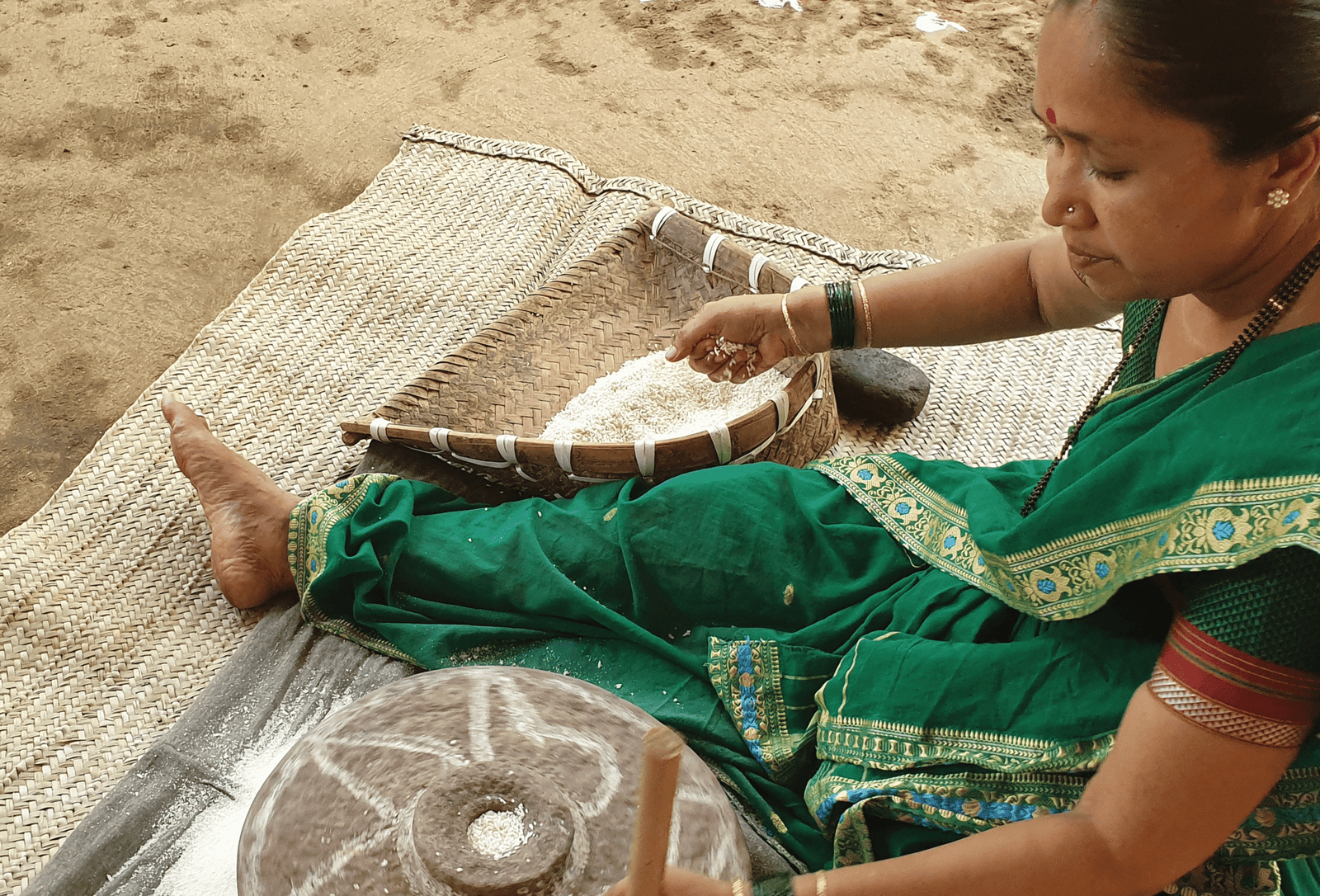
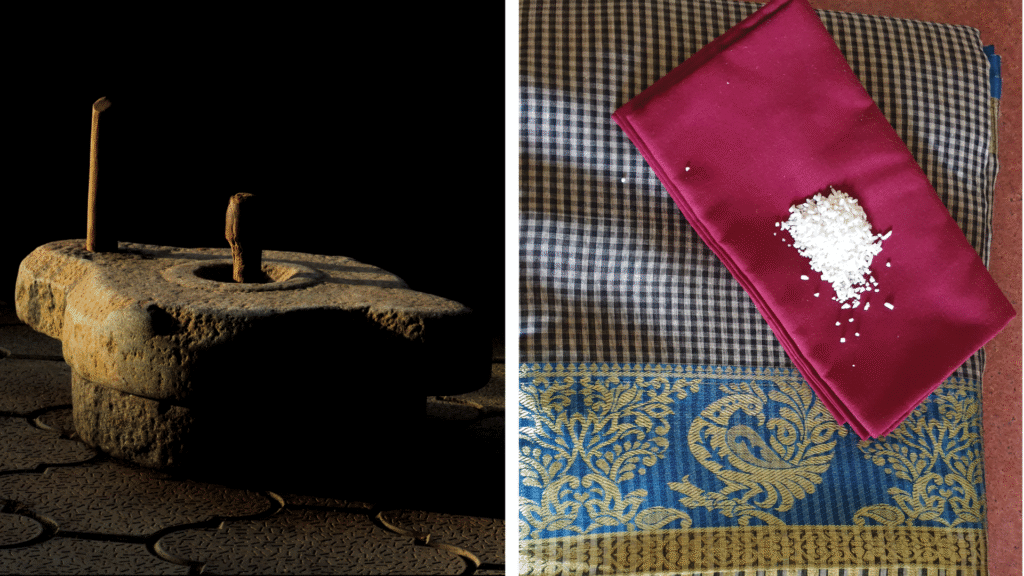
The grinding stone that the bride had carried from her mother’s or grandmother’s would be remembered as having been brought by her but over which she did not have exclusive rights. Any female member of the house could use the grinding stone. This non-exclusivity extended to neighbours and other relatives as well. It was brought in by her but once there, it belonged to the house. It became a household object, accessible to all.
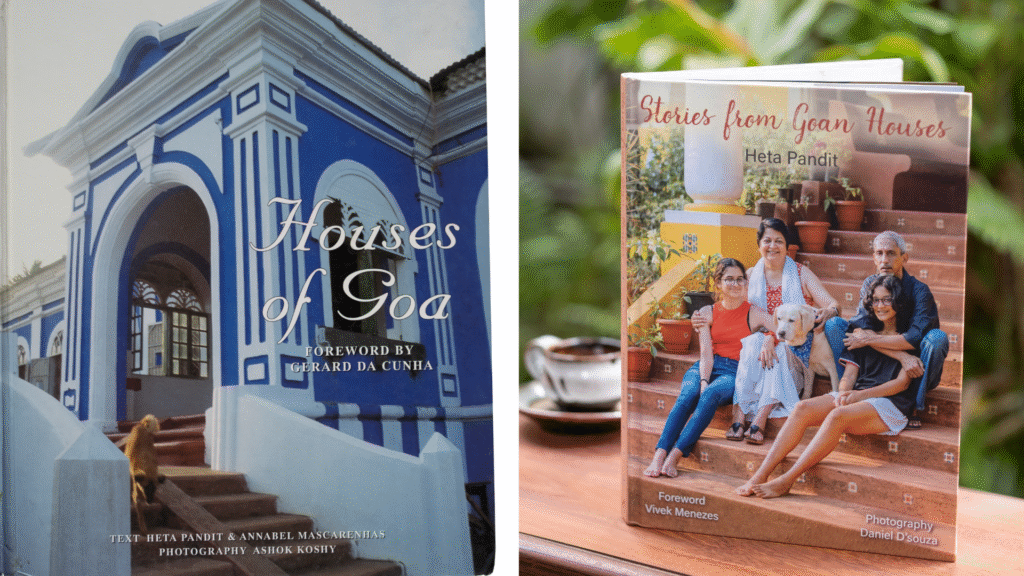
Research and writing sometimes have a way of finding you. I arrived in Goa in July 1995, with absolutely no intention of doing anything. The only three people I knew here were Ar Sarto Almeida, his wife educator Therese Almeida and Efeminio (Babush) Godinho who worked in the Town & Country Planning Department then. Babush introduced me to architect Gerard da Cunha and my oral history research in Goa began.
Interviews can sometimes be quite misleading. One of the tight ropes you walk on is prompting the subject and then getting the replies that she thinks you want to hear. The other thing is whether to go with a reference to meet the subject or make a cold call. In such a scenario, it is very important for the researcher to carry samples of previous interviews, books, papers, videos or any other material that gives the subject an idea of what the final product will be and how publicly accessible it will be.
In my experience, interviews with the storytellers for the book Grinding Stories-Songs from Goa was a huge learning curve. Saraswati Dutta Sawant has never seen the inside of a school building and does not own a mobile phone. Yet, when I was taking notes down by hand, in my notebook, she asked, “Tujhya kade Mobile na? Kityak bhuroita?” (Don’t you have a mobile phone? Why are you taking notes by hand?”) So when I began recording the interview, she then proceeded, not just to answer all my questions but also to demonstrate how she draped her sari to include eight pockets that could hold anything from mangoes, coconuts to twigs for tinder! That is the beauty of oral history. You can set out to document one thing and come across other things that you had not even considered before. Sometimes, it is a case of more is less. That more may come in useful later or may come in useful to someone else. Shared information is growth.
It was architecture that took me to the world of oviyos, songs that are sung at the grinding stone by women in Goa. It was the year 2017 and Bhai Rajendra Kerkar, folklorist, his wife writer and columnist Pournima Kerkar and their long-time associate Shubhada Chari led me to the Shree Mauli temple in the village of Zambaulim, embarking on what I thought was an architectural field trip. Bhai knew that I was studying the architectural art form of kaavi that had originated in Goa. The temple had the most interesting and exquisite rendering of this art on its walls.
Kaavi art is an etching art form where the wall is plastered with lime, the drawing etched out and then filled with a paste of kaav or red soil. It can also be done the other way round, with the red paste layer applied as a base and then the etched out design filled in with white lime plaster. On account of the designs being in the form of shells, fish, lotus buds, half open lotuses and cobra heads and intertwined tails, one could even classify this art as aquatic art. Here was art that fit into several descriptions-architectural, soil, aquatic and folk narrative art.
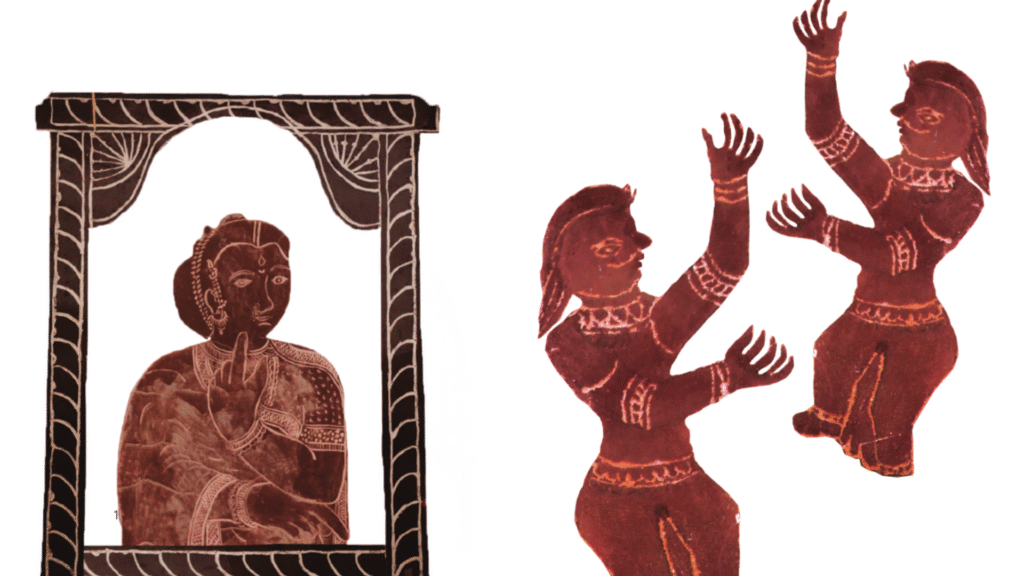
As it turned out, the temple walls were a catalogue of borders, mandalas and narrative figurative art. One of the most interesting was that of a divine Garuda holding the King Cobra aloft in a benign gesture. Were they not supposed to be enemies? Indian mythology relates stories of eagles preying on snakes. Here, in this etching, a divine Eagle, Garuda was rendered rescuing the King Cobra, Bhujang. I was puzzled. Bhai smiled. He said, “there was a flood. The King Cobra was drowning and the Divine Eagle rescued him. In Goa, if we see our enemies in trouble, we rescue them. We put aside our enmity.” Has this story been documented anywhere? “Not yet,” Bhai smiled, “I will introduce you to the storyteller who sings these stories while grinding grain at the grinding stone.”Subhadra Arjun Gaus was the obvious first choice as she was the one who sang the Bhujang and Garuda story. Interestingly, this oviyo is not always sung at the grinding stone. Even more interestingly, Garuda is simply referred to by her as the “Pakashi or Bird”.
Subhadra’s repertoire comprises songs that speak of a deep love between a brother and a sister. The songs refer to a uniquely Goan concept of a paath cha bhau, a brother that is born soon after the sister and thereby elevates the social status of the daughter in the family. This itself is a reflection of the status of women in Goan society. There are songs that restrict the new bride’s travel back to her maternal home after marriage. Subhadra pointed out to the bank of the river across from her own home when she related this song. “I could see my mother’s house across the river. Yet, my mother-in-law said the river was in spate and it was too dangerous for me to go across.”
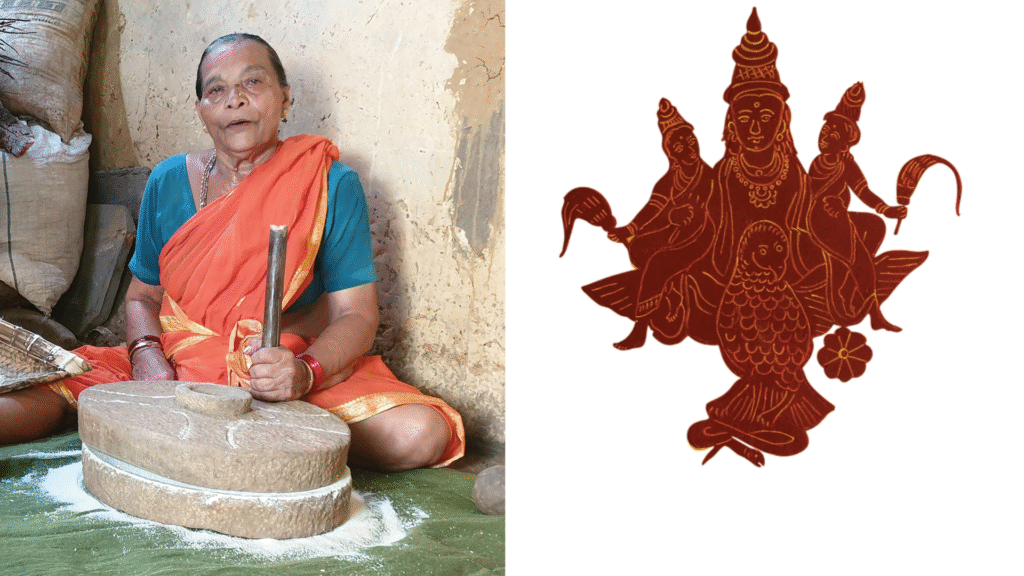
Interestingly (and perhaps universally), when a daughter marries she is “given away”. Saraswati Dutta Sawant sings, “I was given to the village of Poriem or was the village given to me?” To elaborate, Saraswati Aai is neither literate nor has she had a chance to develop any particular skills outside of household chores. Her ability to sing oviyos from memory, however, sets her apart. In Goa, widows are not generally invited to auspicious ceremonies like weddings, naming ceremonies, etc. Despite being a widow, however, Saraswati Aai is invited to weddings because of this ability.
Saraswati Aai’s repertoire of songs include one in which the protagonist is held in suspicion by her mother-in-law, is subject to starvation but is shown some level of kindness when her husband finishes his meal and leaves the choicest leftovers for her to eat. In many parts of Goa, women were not served their meals in their own thalis. They were expected to eat what leftovers their husbands left for them. Just as brides were married off young, some teenage novice priests were also sent off to weddings to officiate in case their fathers were unable to attend to their duties.
“With this song I request the priest’s son
To come to the ceremony with grave decorum
Leave the betel leaf creeper alone
It goes up the coconut tree
Like a serpent.”
We hear a warning here for the young priest not to allow his eyes to wander and stay focussed on conducting the rituals. Warnings like these were often conveyed through song and obtusely in jest. The young novices who officiate at a wedding are often betrothed themselves. Hence the warning through song. “Don’t pluck the leaf off the creeper/For fear it might strike you dumb/Your lips will be stained red/and you will be speechless for a month.”
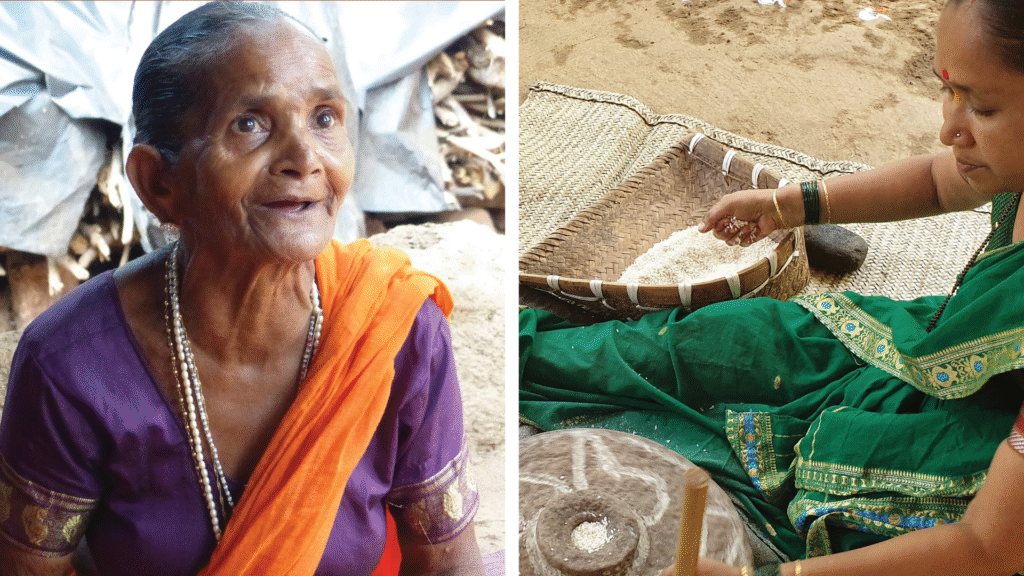
Fidelity and praise for one’s husband “who is a prince” or “who is the only gem I need” is also a recurrent theme. Now this is the most fascinating aspect of carrying out oral history collection and documentation. Why didn’t I stop? Because, a) These songs were highly endangered and b) the storytellers were past their prime c) for some reason, daughters-in-law were not given custody material d) the introduction of electric gadgets did not necessitate the use of the grinding stone anymore e) daughters-in law were highly educated and probably working women and had little or no inclination to grind grain by hand, and f) the content of the material did no longer fit into the social psyche of current day status of Goan women.
The methodology for the collection was fairly simple. I set about with a notebook and pen and asked the storyteller for her collection of songs. I was not as adept at understanding the language (a dialect of Marathi and Konkani) and Shubhada Chari, a long-time associate of Bhai Rajendra Kerkar and Mrs Pournima Kerkar, helped me with the translations. The outcome was published in a book titled Grinding Stories-Songs from Goa.
It was when I went to present a copy of this book to the then Curator at the Central Library Dr Carlos Fernandes that some new information on oviyos came up for discussion. Dr Carlos sent for his entire staff to show them a copy of the book and then, after reading Bhai Damodar Mauzo’s Foreword out aloud asked them to help me find Christian Gawda women who still sang oviyos. Bhai Mauzo had mentioned the historical fact that Konkani language had practically been banned from everyday use by the erstwhile Portuguese government in the year 1684. Dr Carlos Fernandes and his team now took it upon themselves to find, for me, Christian women from this community in Quepem who had kept this genre of folk music secretly alive.
Most of the content of the songs collected from Amelia Dias, Louisiana Fernandes, Gloria Dias and Carminia Fernandes were songs sung at weddings. The songs also had social innuendos and warnings and alluded to subjects that were otherwise taboo. “These buds are not for you, dear boy/those buds are not for him either/you boys are loitering on that road/you’ve been bewitched by the girls wandering aimlessly/on the same road/but they are the mogra flowers/that don’t bloom quickly/they don’t open so soon…” In some songs, women are perceived as seductresses. In others, they are perceived as being so delicate as “our daughter only drinks from a clear spring/if she drinks tap water you’ll see/she will wilt like a fallen leaf.”
Stories from Goan houses began with a request from Upendra Gaunekar of Bandora to write about the histories in the interest of posterity. Upendra’s wife Sangita came from the house of the Mhamai Kamats, a town house now in Panjim. Here, there were stories of how an image of Lord Ganesh was drawn on paper when there was a ban on celebrating the festival and how this image was hidden in the many boxes in the house, with only the head of the family aware of where it had been hidden. Interestingly, the practice continues, 65 years after colonial rule has ended.
The story of the Dempo family is linked to the house of the Mhamai Kamats. The Dempos had fled to nearby Karnataka and when they returned to Goa, they stayed at the Mhamai Kamat house, waiting while their own house Casa Dempo was under construction. When the religious Orders in Goa were banished in 1835, the Dominican Convent in Calapur in Panjim’s suburbs came up for sale. The Dempo family bought it and turned the Convent into a townhouse fit for entertaining business associates from Panjim.
Casa Guilherme in Salvador do Mundo had its own share of stories about travelling to Panjim in canoes along the river extending these stories to present times. Hand drawn paintings on the walls in this house led to paintings on walls in other houses.
The ornithologically accurate paintings at the Pai Raikar House in Savoi Verem came as a delightful surprise. Artist Subodh Kerkar, more than 20 years ago, shared a book titled Forgotten Art published by the Department of Information, Government of Goa. There were paintings in this book from Goan houses but no references. We did not know where these drawings were from and did not know where to start looking.
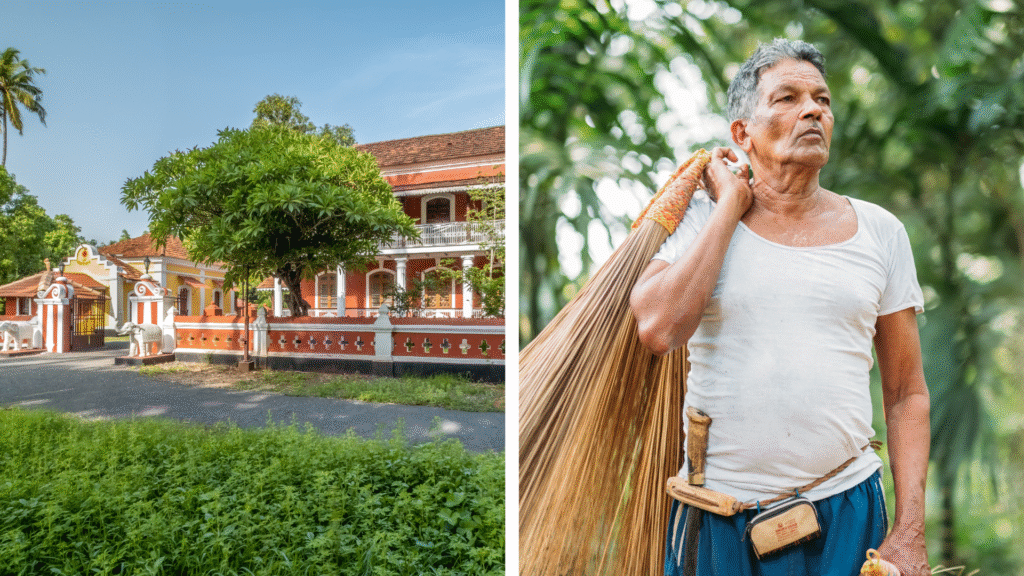
Until we stumbled upon them at the Pai Raikar House. This house was a house of writers and performers and interestingly, these drawings were done on the walls as references for male actors who were impersonating female characters in mythological operettas. The reception room upstairs had fallen into disuse when the performances ended. When a family member brought a broom to sweep the soot and cobwebs away from the walls, we decided to include storyteller Lakshmi Vishnu Harvalkar’s house in Brahma Karmali. Lakshmi’s husband Vishnu makes brooms by hand and lights his beedies with two flintstones when he feels like a relaxed smoke. Vishnu is also a herbalist.
This led us to the house of Dada Vaidya, one of Goa’s most celebrated ayurvedic doctors and the story of how he saved the life of the Portuguese Viceroy’s son that resulted in the ban on ayurvedic practices being lifted permanently in Goa.
Although I had known most of these families for over two decades, these stories had not been shared earlier. It takes many years and several social visits for trust to be built up between the interviewee and interviewer. To build trust, you need more than time. Trust is a two-way street. If someone shares a story with you, you have to also learn to trust the storyteller and the story. In Goa, however incredulous the story may seem at first, you must learn to believe. It is, at the end of the day, oral history.
Authored by Heta Pandit
This article is an extract from the Keynote Address delivered by Ms. Heta Pandit at the workshop on Documentation of Folklore and Oral History of the Konkani People held by the Goa State Audio Visual Archives, Department of Archives, Government of Goa in collaboration with the Thomas Stevens Konknni Kendr, Porovirm on 15-16th July 2026.