
For centuries, dogs have been a familiar presence in art and human life. In art, they have appeared in different roles: as companions, markers of social status, beloved pets, working animals, comic figures, and sometimes simply as animals being themselves. Their presence can tell us something about the people who lived alongside them, the spaces they occupied, and the relationships they formed with humans. Across different periods, the role of the dog changes, but its presence remains remarkably consistent. Animals have rarely existed entirely outside human social and cultural worlds. Dogs appear beside hunters, rulers, artists, and families. Scholars working in human–animal studies have increasingly questioned the idea that these relationships can be understood only from a human perspective. Instead, they examine how animals themselves participate in shaping the spaces and relationships they inhabit. Seen from this perspective, the dog in a painting is not only a representation, but part of a larger history of humans and animals living alongside one another.
Anyone who walks into the Museum of Goa encounters Viraj Naik’s colossal drawing The Triumphant Trio. At the lower left of the work, a dog curls up alongside human figures, a detail that is easy to notice and hard to forget. At MOG, dogs also appear repeatedly in the Goan paintings of Chandrakant Shankar Kerkar (CSK) from the 1960s, accompanying villagers and forming part of the everyday scenes he depicts. Here, the dog is not necessarily the subject of the painting, but an ordinary presence within the landscape of Goan life.
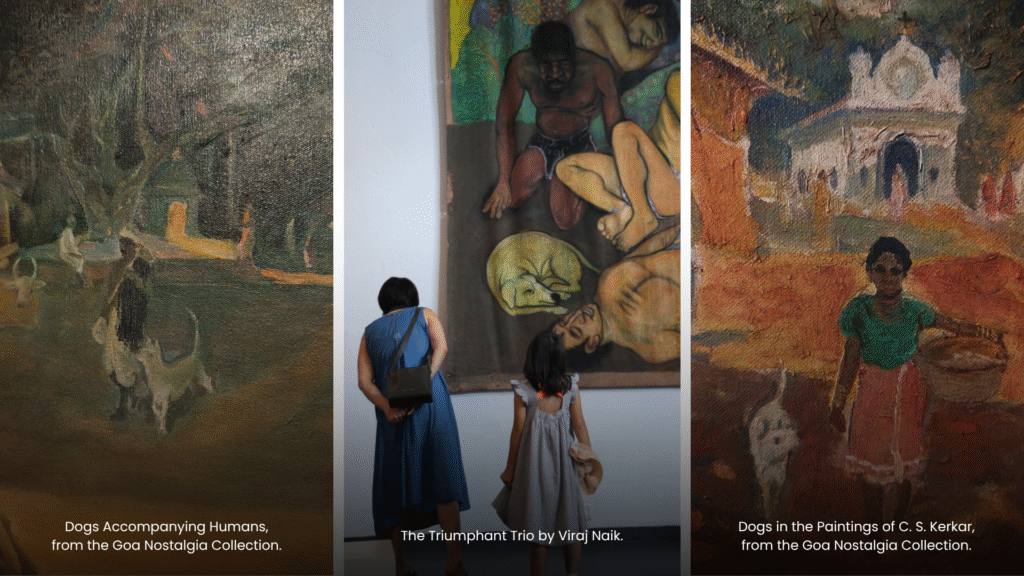
At MOG, however, they are not just represented in paintings or sculptures. Dogs are physically present within the space itself, walking through galleries, resting beside artworks, observing the making of art and becoming part of visitors’ own museum experiences. Many museums across the world have made their galleries pet-friendly. MOG’s Good Practices and Regulations policy allows visitors with pets inside the galleries too.
A museum is usually imagined as a human space: humans make the art, humans curate it, humans look at it, and humans interpret it. This connects to the broader idea of more-than-human spaces, where human beings are not considered the only meaningful participants in a place. Recent animal-geography research specifically asks how animals actively shape public spaces rather than merely being accommodated within spaces designed by humans.
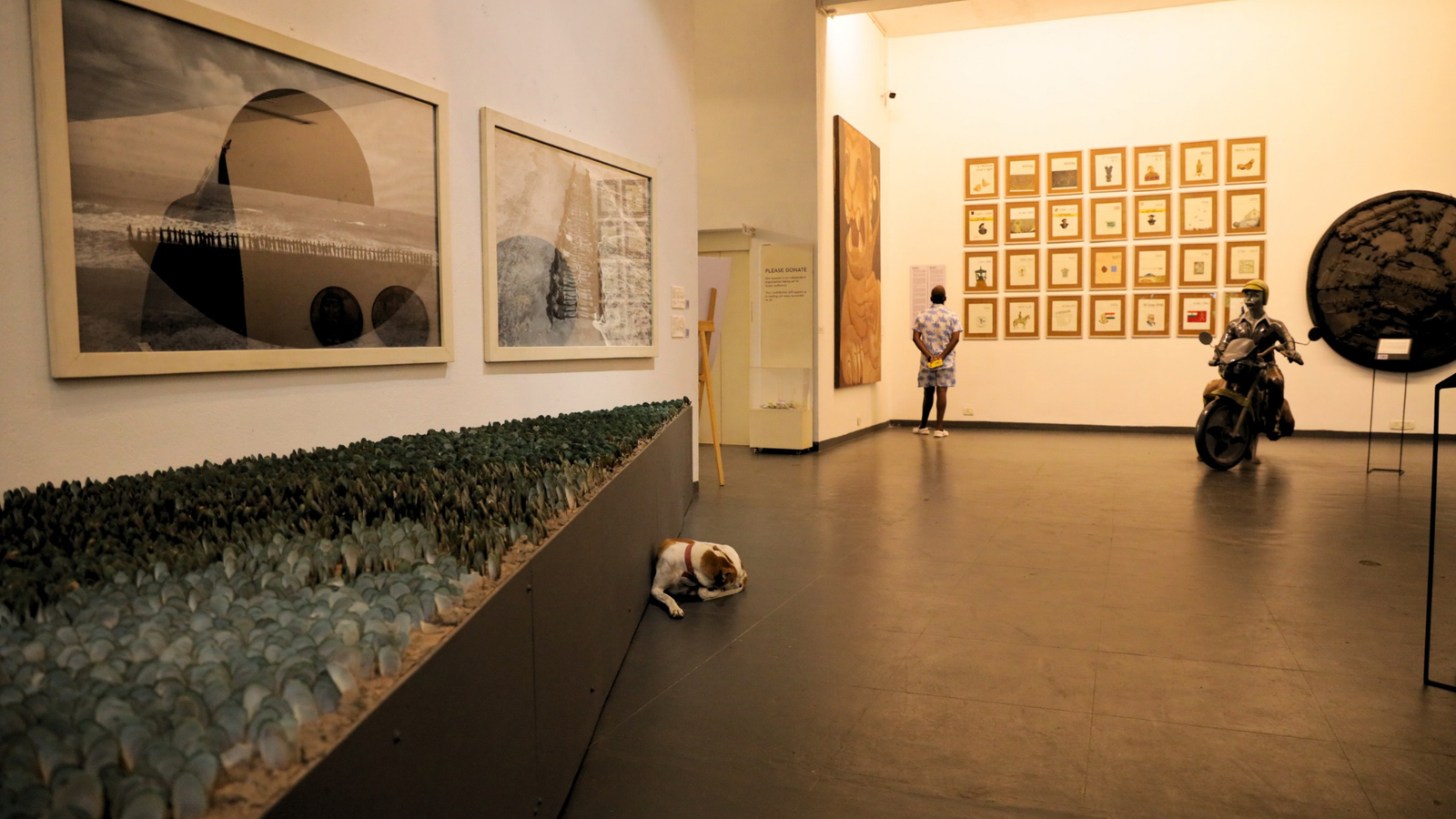
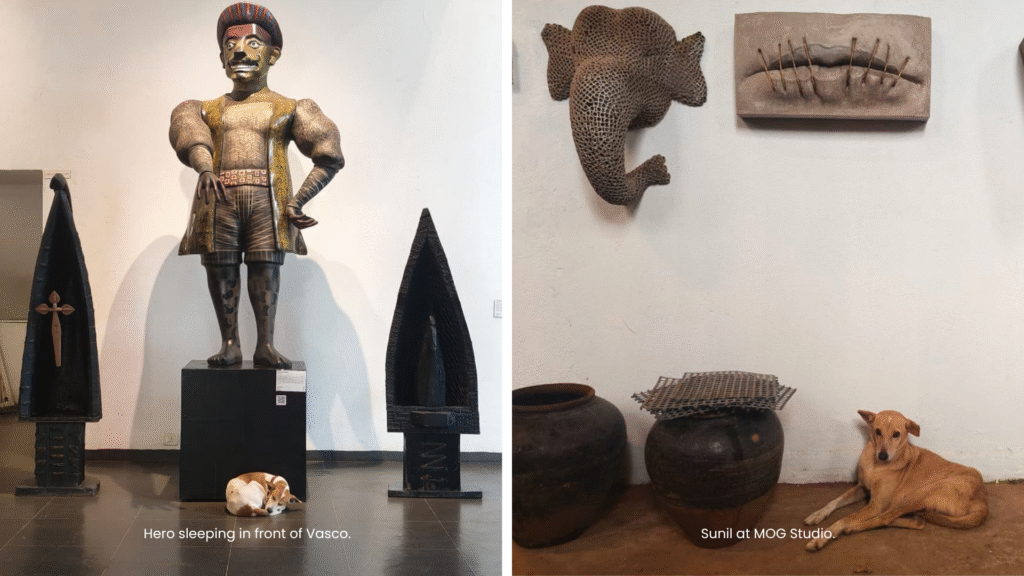
Hero, the museum dog sleeping beside an installation, Sunil, the dog at MOG Studio quietly observing the making of artworks at the Art Studio, or a visiting dog who gets fascinated by an artwork may seem like small moments. Yet these encounters have gradually become part of the MOG story. Hero, Butloo, Bubloo and Dobby are familiar faces around MOG, while Sunil, the calm and observant resident of the Art Studio, has become a presence in the making of many artworks. Together, these five dogs have become part of the museum community. They are not simply visitors or companions; they are in the memories and stories of the museum. Museum educator Aparna has spent considerable time observing this relationship between animals, visitors and the museum. In conversation, she recalled how often a dog can transform an ordinary museum encounter into something more.
Museum with Dogs
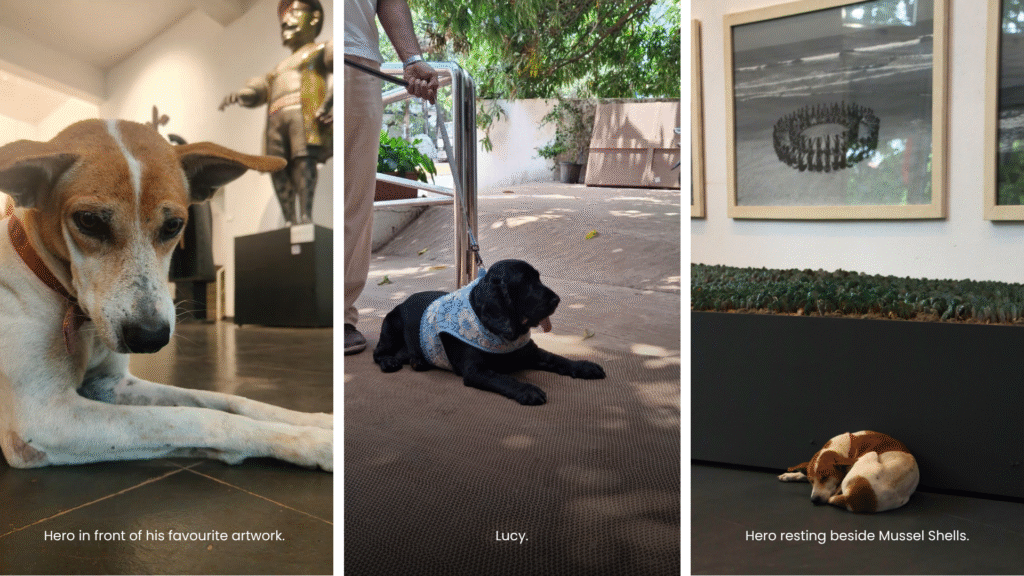
According to Aparna, dogs often become the centre of spontaneous conversations. She remembers a black Labrador once (Lucy) walking into the museum and immediately changing the mood of the space. Rather than being concerned, visitors became excited. Pet parents, in particular, often ask whether dogs regularly come to the museum and are happy to discover that they are welcome. Various research shows that dogs can facilitate interactions between strangers in public spaces. In sociological studies, researchers found that dogs could make their human companions more approachable and create opportunities for strangers to interact.
“There is a sense of community,” she observes. The presence of dogs makes the museum feel a little more relaxed, informal, and fun. Hero, in particular, has become almost inseparable from the gallery experience. He is the dog most frequently seen inside the galleries, and children especially enjoy encountering him. He often sleeps among the artworks and has appeared in countless visitor photographs. For many people, photographing the artwork also means photographing Hero alongside it.
When Dogs Meet Art
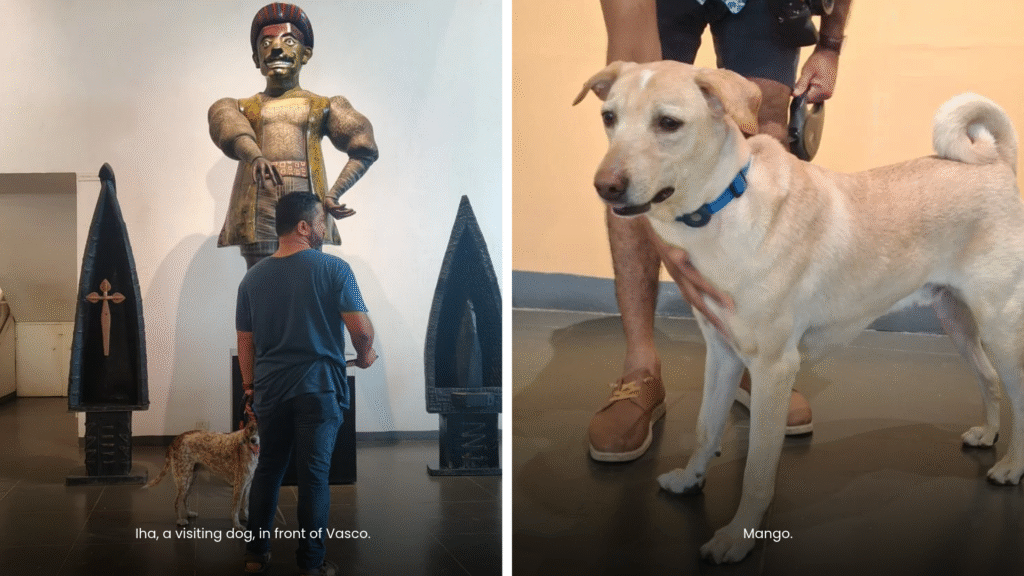
Over the years, many visiting dogs have developed their own relationships with the museum space. Aparna remembers Mango, the first dog she encountered at the museum. She remembers Mango as a young, curious dog who enjoyed walking around the galleries, although the Narakasur installation was clearly not her favourite artwork.
Then there was Atticus, a greyhound-like dog whose owner described him as “not a people pleaser.” Despite that, he was calm and enjoyed the museum space. During the mango exhibition, Toasty was particularly curious about the gallery and seemed especially excited by Pandurang’s mangoes. These encounters are often funny and fleeting, but they create their own small museum memories. Sometimes visitors themselves begin pointing out artworks to their dogs, turning the act of looking at art into something shared between human and animal. And, occasionally, the dogs seem more interested in the physical space than the artworks themselves. Aparna remembers one particularly enthusiastic dog who wanted to run around a fragile ceramic work. The owners were understandably nervous, even as the situation remained amusing and endearing.
The Dog as a Conversation Starter
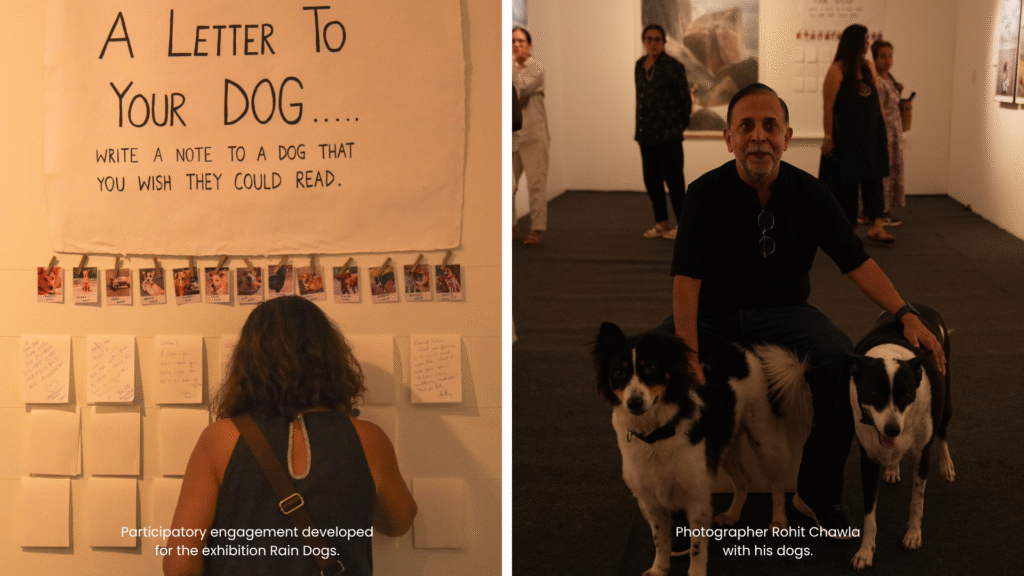
Visitors often notice the dogs before they notice anything else. Aparna has observed that people’s expressions change when they see a dog inside a gallery. Many instinctively look towards a member of the museum staff, almost asking for confirmation: Are dogs really allowed here? The answer is yes. For visitors who arrive with their own pets, this can be especially meaningful. Some are initially surprised that their dogs are welcome inside the museum. Others walk in naturally, as though bringing a dog to a gallery is the most ordinary thing in the world.
The dogs also create conversations between strangers. Visitors who might not otherwise speak to one another often begin by asking about a dog’s name rather than the name of an artist or artwork. Aparna herself has found herself becoming part of these conversations. A visitor might come in with a dog, and suddenly a small conversation begins. What starts as a question about the dog can become an informal mini-tour of the museum.
Dogs and Children
For children, the presence of dogs can be especially powerful. A museum can sometimes feel unfamiliar or intimidating to a young visitor. But a dog can immediately provide something familiar and approachable. Aparna has noticed parents using the dogs to redirect a child’s attention when they become restless or upset. A crying child might suddenly stop when someone points out a dog nearby. And the relationship does not necessarily end when the family leaves. Children who often return to the museum ask about the dogs by name. They remember Hero. They want to know where he is. They come back looking for him. The dogs therefore become part of a child’s memory of the museum, sometimes even before they remember the name of an artwork.
This also offers an observation about how museum memories may be formed. Visitors’ experiences of a museum are shaped not only by their encounters with objects and artworks, but also by the people, sounds, movements, and unexpected moments they encounter within the space. A child, for instance, may notice and remember a dog sleeping beside an artwork, and that moment may become part of how they recall their visit. Such encounters suggest that the informal and everyday elements of a museum can sometimes find a place in visitors’ memories, even when they do not form part of the exhibition itself.
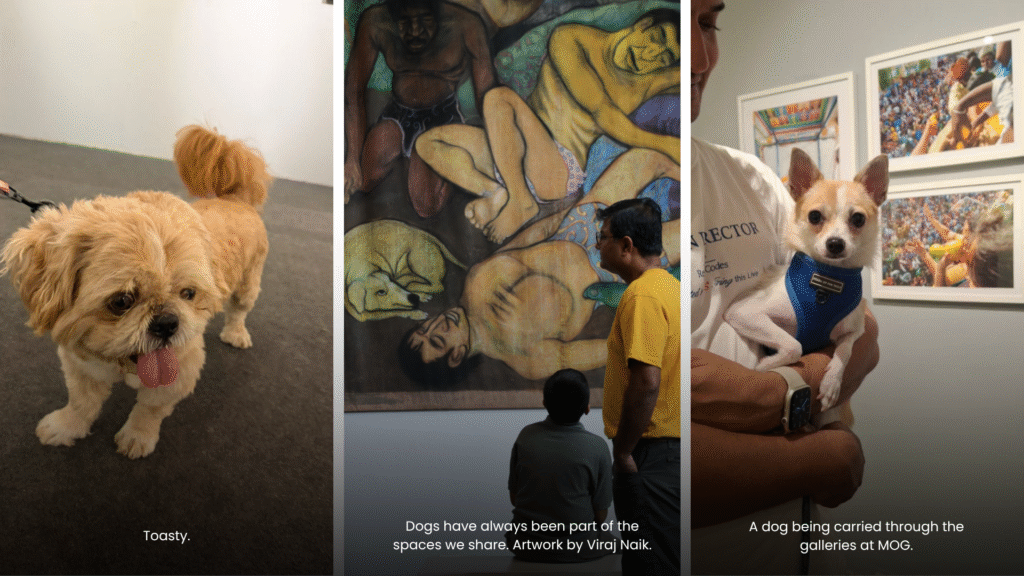
The relationship between visiting pets and the museum environment is not always the same. Some dogs are calm and move through the galleries naturally. Others are more excited by the unfamiliar environment, and their owners can become concerned when they bark or move too close to an artwork. But this too is part of creating a genuinely pet-friendly space: recognising that animals, like people, respond differently to new environments. Aparna remembers visitors bringing dogs of all sizes and personalities. Some are carried throughout their visit, almost like an accessory, while others walk confidently beside their owners.
More Than Companions
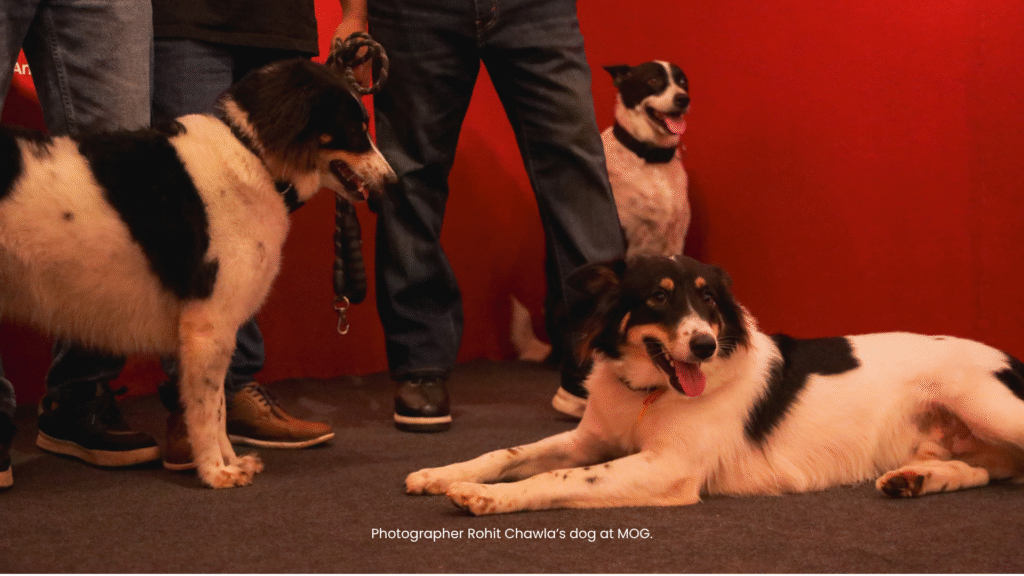
The dogs do not simply occupy the museum; they participate, in their own small ways, in making its everyday life. Their presence raises a larger question about what it means for a cultural space to be welcoming. Museums often speak about accessibility, participation, and belonging in relation to human visitors, but the presence of animals invites us to think beyond that framework. What happens when a museum becomes a space shared across various beings?
At MOG, there may be no deliberate attempt to answer this question through the dogs themselves. Yet their everyday presence offers an unexpected way of thinking about the museum as a shared social space, one shaped not only by exhibitions and programmes, but also by encounters, routines and relationships. Together, they become part of how the museum is experienced and remembered. Perhaps this is what makes a museum welcoming: not simply that it allows people to enter, but that it leaves room for unexpected forms of connection. Sometimes, that connection comes with four paws.
Authored by:
P S Soorya, Publication Associate in conversation with Aparna Parameswaran, Museum Educator
References
Yan, Y. (2025). Pet’s Right to the City: Animaling public space. Geography Compass, 19(3). https://doi.org/10.1111/gec3.70024
Robins, D. M., Sanders, C. R., & Cahill, S. E. (1991). DOGS AND THEIR PEOPLE. Journal of Contemporary Ethnography, 20(1), 3–25. https://doi.org/10.1177/089124191020001001