

October 31, 2026 - October 31, 2036
Included in MOG Ticket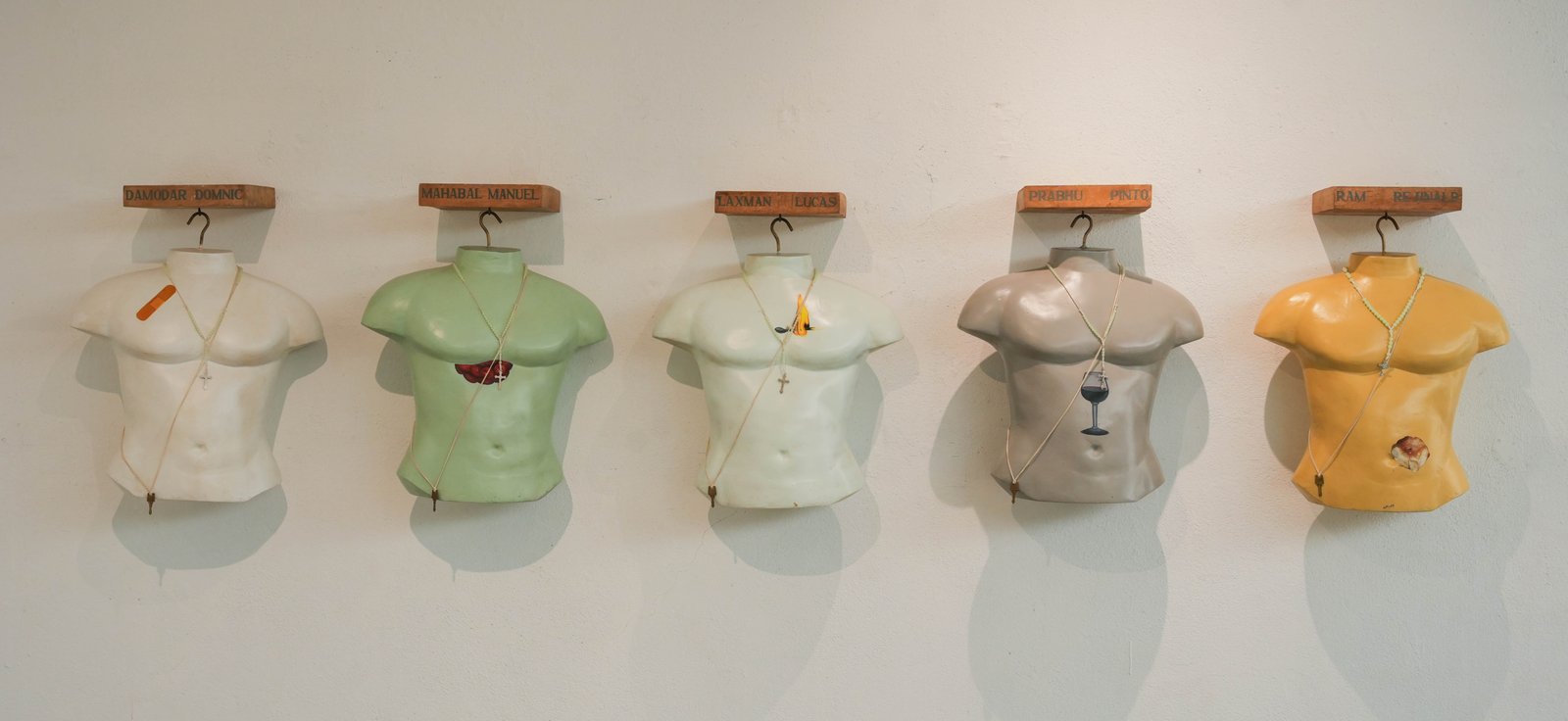
Histories of Goa
The exhibition Histories of Goa examines Goa’s history through contemporary art, highlighting Portuguese rule, cultural exchanges during colonization, significant historical events under various rulers, and contemporary themes surrounding ideas of food, identity, cultural practices and landscape in Goa. Over 20 local and national artists present these diverse perspectives. Rather than presenting history as a fixed sequence of events, the exhibition approaches it through multiple perspectives, connecting historical developments with the experiences, practices, and memories of communities.
The artworks interpret history through materials, objects, and visual narratives drawn from everyday life. An old fishing boat becomes a record of maritime traditions; bread, chillies, tea, and cashew nuts reveal the movement of ingredients across continents; and works addressing caste, religious conversion, trade, and colonial conquest raise questions about power, identity, and cultural change. Other works turn to Goa’s natural environment, exploring the relationship between communities and the sea, the effects of mining, and the transformations of its built landscape. Together, these interpretations reveal how histories are carried not only through written records and monuments but also through objects, materials, food, occupations, and cultural practices.The exhibition encourages visitors to consider how the past continues to shape the present.
Curatorial Approach
Histories of Goa uses contemporary art as a means of exploring and interpreting the past. Instead of following a single chronological narrative, the exhibition brings together different historical periods, subjects, and perspectives. Artists engage with historical events, cultural practices, archival accounts, and material traditions, translating these into works that invite observation, and interpretations.
Materials play an important role in this approach. Old wooden boats, mussel shells, cowrie shells, laterite stone, tea, bread, and other familiar substances become ways of examining histories of trade, labour, migration, belief, and environmental change. Their significance extends beyond their physical properties: they carry associations with particular places, occupations, cultural exchanges, and lived experiences. By reworking these materials, artists create connections between historical events and the objects that continue to surround us.
The exhibition also places different kinds of histories in conversation. Accounts of Portuguese expansion and colonial rule appear alongside explorations of pre-colonial kingdoms, religious diversity, food traditions, maritime trade, caste, and contemporary environmental concerns. This approach recognises that Goa’s history is shaped by multiple influences and that its interpretation involves examining both the continuities and tensions between them.
What You Will Encounter
Visitors encounter paintings, sculptures, installations, photographs, and works made from materials associated with Goa’s histories and everyday life. These include interpretations of the Kadamba dynasty, Portuguese conquest and colonial rule, the movement of religious traditions, maritime and horse trading, and the histories of food items such as bread, chillies, cashews, and tea. Other works examine caste and conversion, traditional fishing practices, village life, and the environmental consequences of mining and urbanisation. Together, the artworks connect historical events with material culture, community memory, and contemporary questions of identity, belonging, and change.
Themes
Colonial Histories and Power
The Portuguese conquest of Goa in 1510 and the subsequent expansion of colonial rule transformed the region’s political, religious, and social landscape. Artworks associated the alliances and power dynamics with the conquest, relocation of Hindu deities to territories beyond Portuguese control following the destruction and displacement of temples are present. These works invite reflection on conquest not only as a political event but also as a process that affected communities, religious practices, and cultural landscapes.
Faith, Conversion, and Religious Diversity
Religious traditions in Goa have developed through long histories of belief, movement, encounter, and change. Artworks draw attention to the worship of local deities associated with natural elements, the historical presence of Jainism and Buddhism in the region, and the relationship between religious conversion and caste identity under Portuguese rule. These works consider how belief is practised, how identities are negotiated, and how religious institutions and historical circumstances influence cultural life.
Trade, Migration, and Cultural Exchange
Goa’s coastal location connected it to maritime networks linking the Indian Ocean, Europe, Africa, and the Americas. Trade moved not only commodities but also people, technologies, languages, and ideas. Works exploring the horse trade, pepper, tea, and other goods reveal the economic and political relationships that developed through these networks. The history of the slave trade and the movement of enslaved Africans to Goa under Portuguese rule are also part of exhibition.
Food, Identity, and Everyday Culture
Food provides a way to trace the movement of ingredients and the transformation of cultural practices. Works such as Chillies, Pao, Katreacho Pao, Kolmer, and Tea examine the histories of ingredients, baking traditions, and food-related practices shaped by exchange between continents. Ingredients that travelled across oceans became embedded in local cuisines, while bread developed into an everyday staple shared across communities in Goa
Material Culture and Collective Memory
Objects and materials can preserve histories that are not always documented in written accounts. In works such as Memory of a Boat and Fishing Disc, the artist uses elements of traditional wooden fishing boats to evoke the skills, labour, and maritime knowledge associated with Goa’s fishing communities. The worn surfaces of these materials become traces of use and experience
Landscape, Ecology, and Transformation
Goa’s natural environment has shaped its livelihoods, settlements, and cultural practices. The sea appears as a source of sustenance, a medium of travel, and a force connecting distant regions. At the same time, the exhibition examines the pressures placed on the environment by mining, construction, and changing technologies.
Power, Identity, and Social Divisions
Historical systems of power continue to influence how communities understand identity and belonging. Through works addressing caste, colonial hierarchies, religious conversion, and slavery, the exhibition examines how social divisions have been created and maintained. Themes even extend the reflection to the boundaries people construct around nationality, religion, caste, and other forms of identity.
Artists, Contributors & Sources
The exhibition brings together works by over 20 local and national artists, each approaching Goa’s histories through distinct materials, methods, and perspectives. Their practices range from painting and sculpture to installation, photography, and the use of found or reclaimed materials.
Artists represented in the material shared for this exhibition include:
Subodh Kerkar, Viraj Naik, Kalidas Mhamal, Siddharth Gosavi, Pradeep Naik, Shailesh Dabolkar, Sweety Joshi, Santosh Morajkar, Pandurang Naik, Siddhesh Chari, Sarban Chowdhury, Aniket Agarwadekar.
Key Artworks
The following works offer entry points into the exhibition’s broader historical concerns. As the display changes periodically, the works on view may vary.
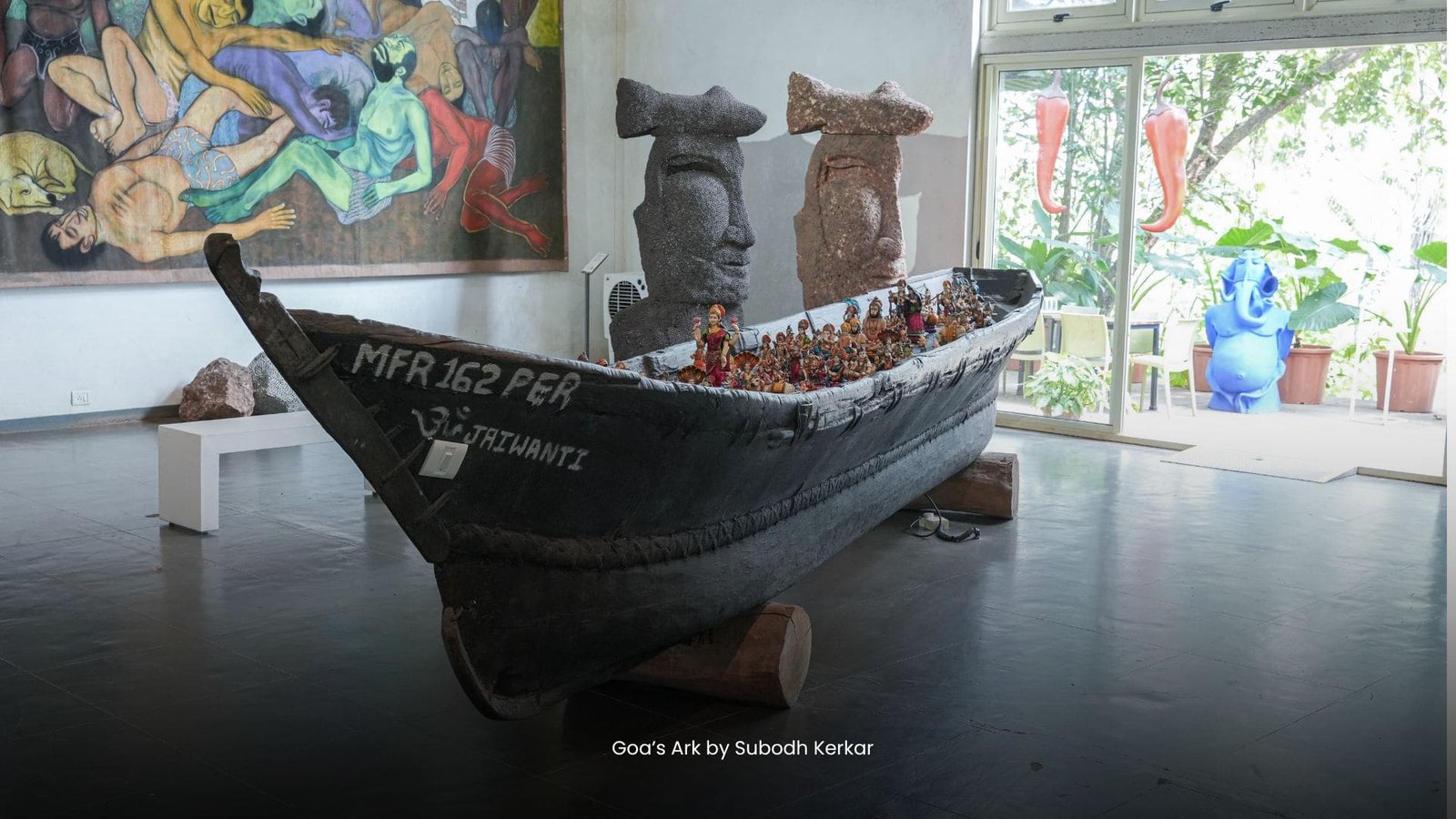
Goa’s Ark — Subodh Kerkar
Using an old fishing boat measuring 22.6 feet in length, Subodh Kerkar creates an installation featuring idols of Hindu deities. The work recalls the relocation of deities from territories under Portuguese control to areas where Hindu temples could be re-established. Its title draws a parallel with the biblical story of Noah’s Ark: while Noah’s Ark is associated with the preservation of life, Goa’s Ark refers to people carrying and protecting their deities. The work also evokes the boatmen of Adpai, whose community has a role in carrying and rocking palanquins during religious festivities.
The Kadamba Lion — Siddharth Gosavi
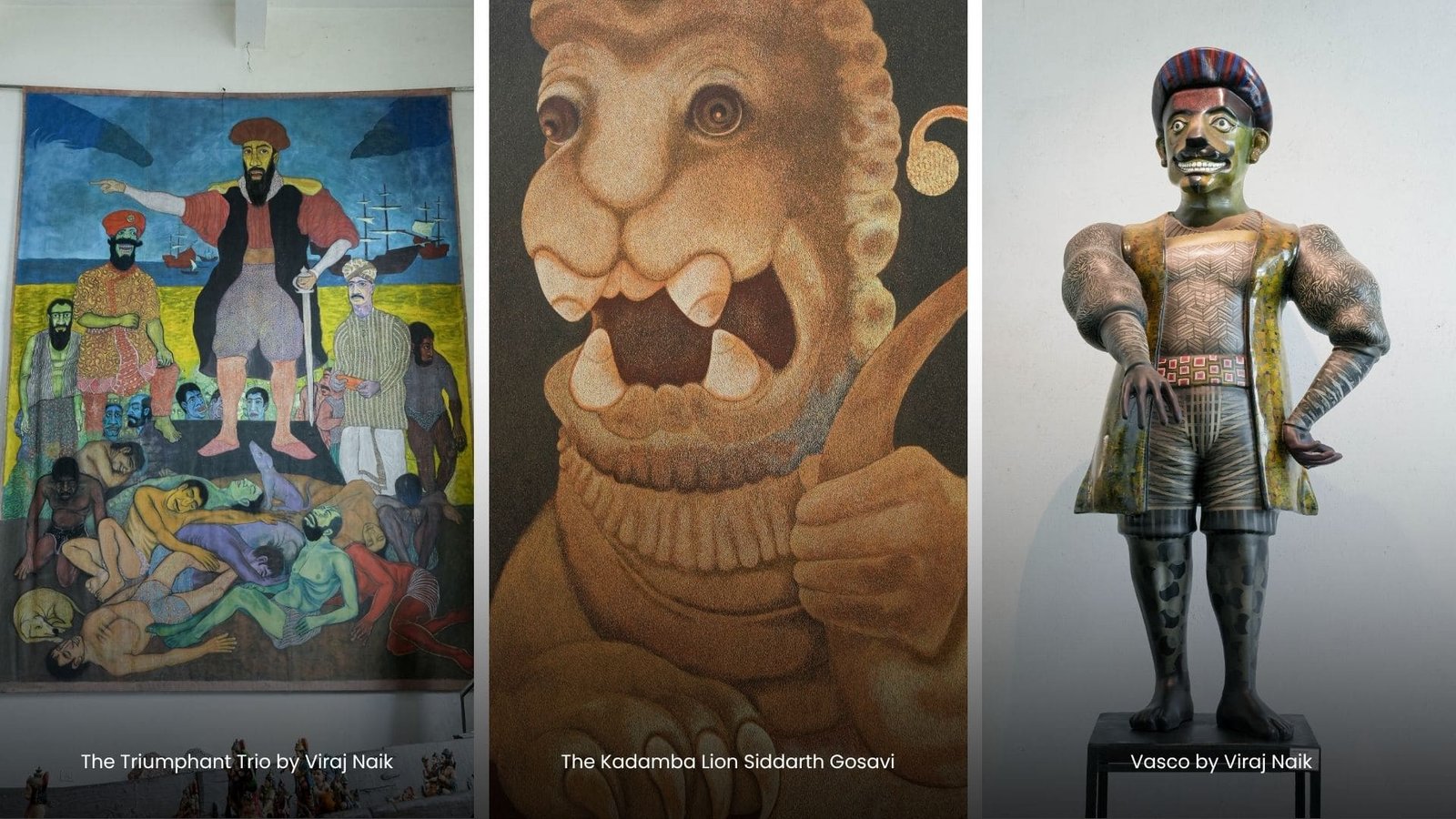
Created through individual strokes using a crow quill nib, this work depicts the lion associated with the Kadamba dynasty, which ruled Goa for several centuries. The Kadambas established an important political and cultural presence in the region, and the lion remains visible in contemporary Goa through the name of its public transport system. The work connects the visual language of a historical dynasty with its continuing presence in public life.
The Triumphant Trio — Viraj Naik
This monumental mixed-media work depicts Afonso de Albuquerque, Thimayya, and Mhal Pai in relation to the Portuguese conquest of Goa in 1510. The composition places the figures above distressed bodies, with Portuguese ships in the background. It examines the alliances and political calculations associated with the conquest while drawing attention to the human consequences of colonial expansion.
Caste Thread — Kalidas Mhamal
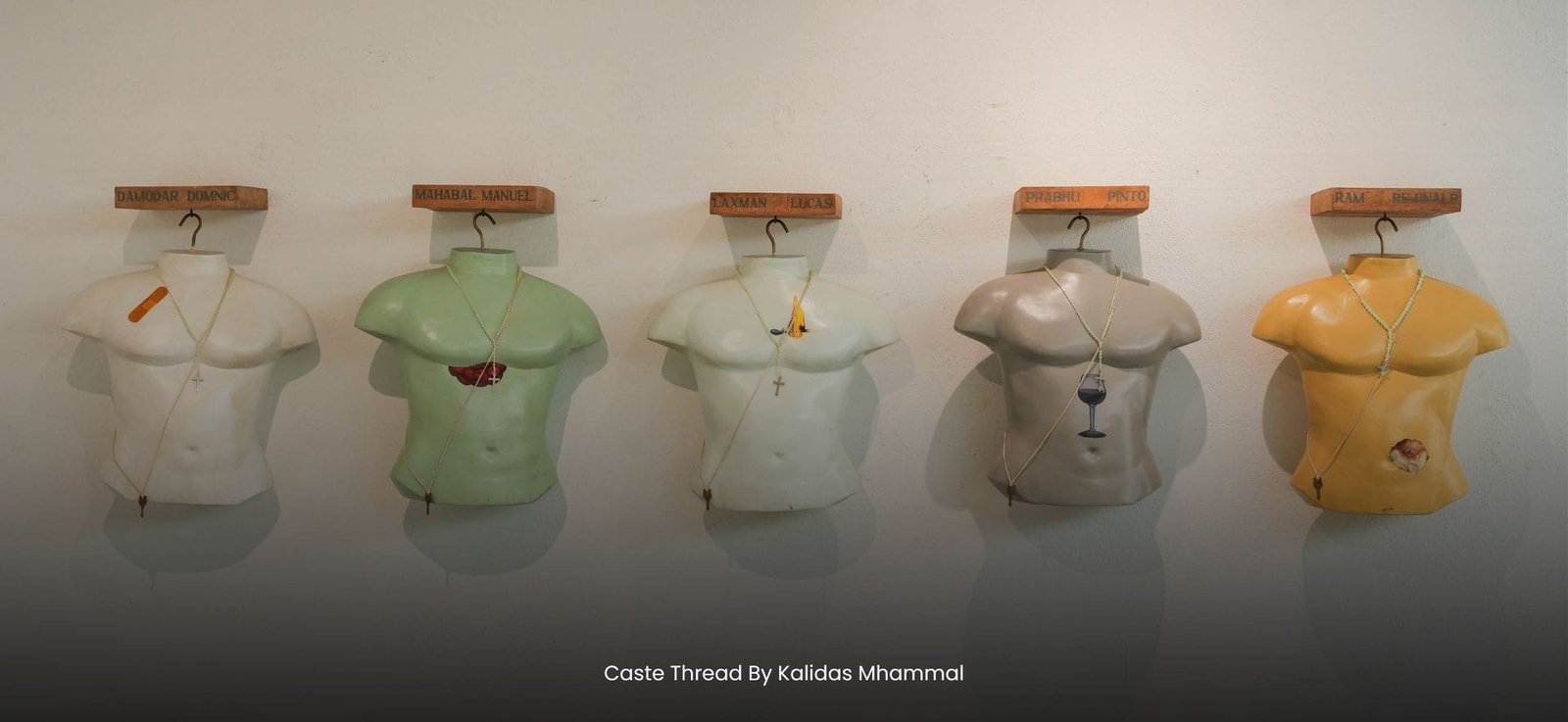
Five mannequin torsos wearing the janeu, or sacred thread, form the basis of this installation. Through images of tools associated with conversion and text relating to changes in names and identities, the work examines the relationship between caste and Christian conversion under Portuguese rule. It raises questions about how social hierarchies persisted and were negotiated across religious boundaries.
Cowrie Disk & Cowrie Fork — Subodh Kerkar
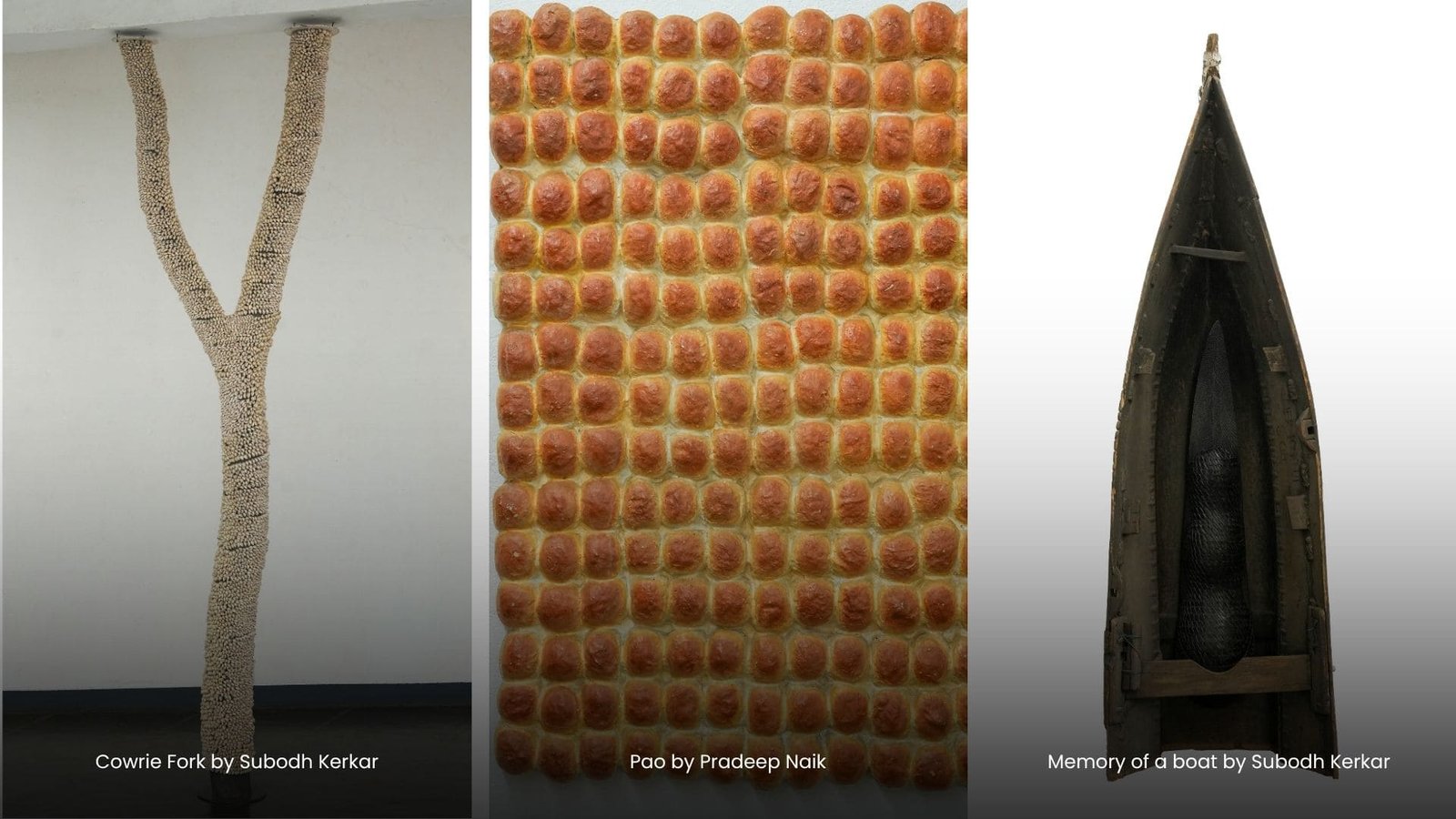
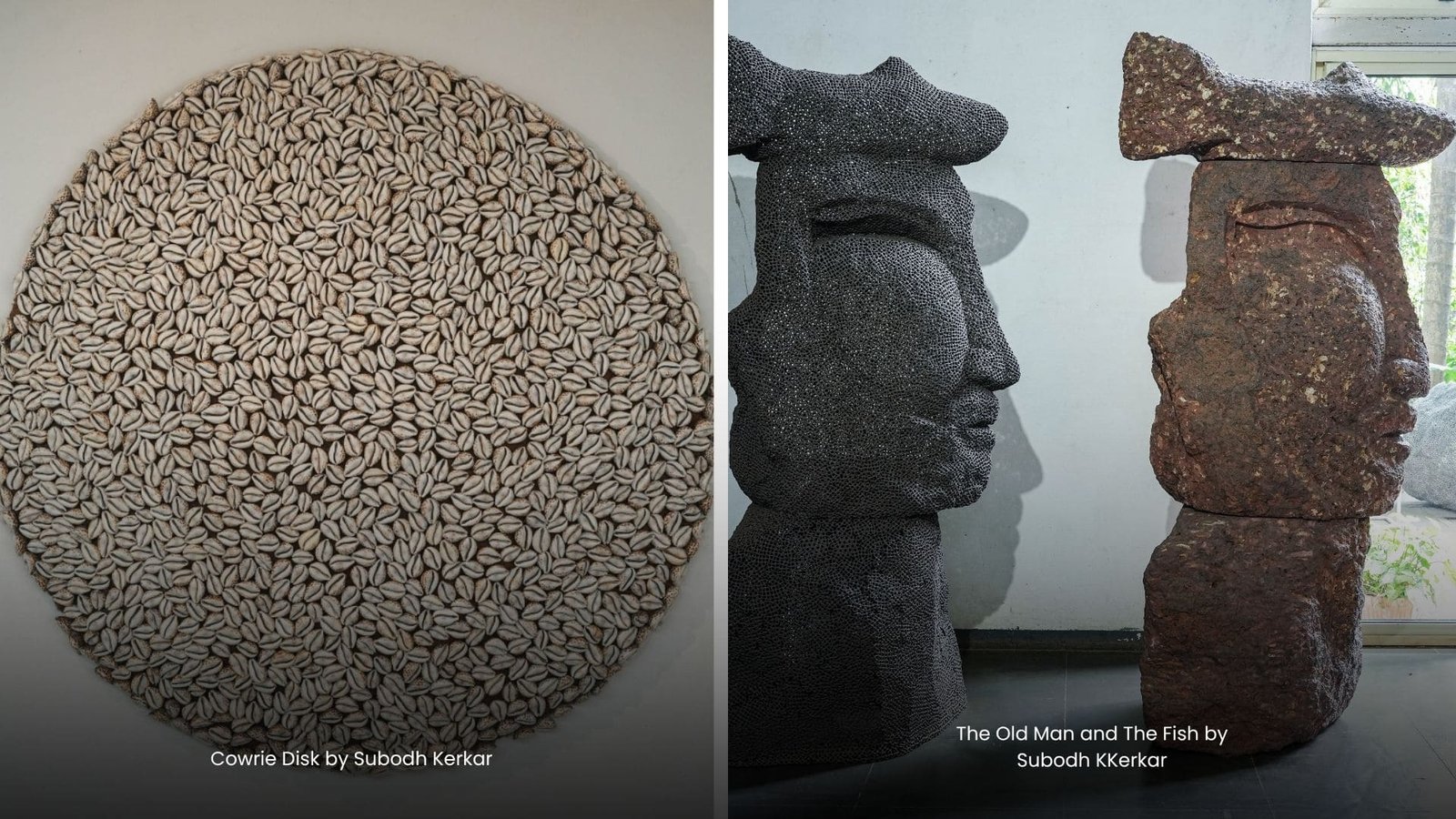
These works use cowrie shells to address the history of the slave trade connecting Portuguese Goa with parts of Africa. Cowrie shells served as currency in some regions involved in these networks, while the forked branch refers to the restraint of enslaved people. The works bring material form to a history of forced movement, exploitation, and the commercial systems that sustained slavery.
Goa Diaries — Kalidas Mhamal and Subodh Kerkar
This series of 32 paintings presents dates and events associated with Goa’s history, ranging from geological formation and early evidence of life to colonial history and developments in contemporary Goa. Kalidas Mhamal illustrates the series, while Subodh Kerkar compiles the historical narratives. Together, the works offer a chronological point of reference within an exhibition that otherwise approaches history through diverse artistic interpretations.
Food Histories: Pao, Chillies, Tea, and Kolmer
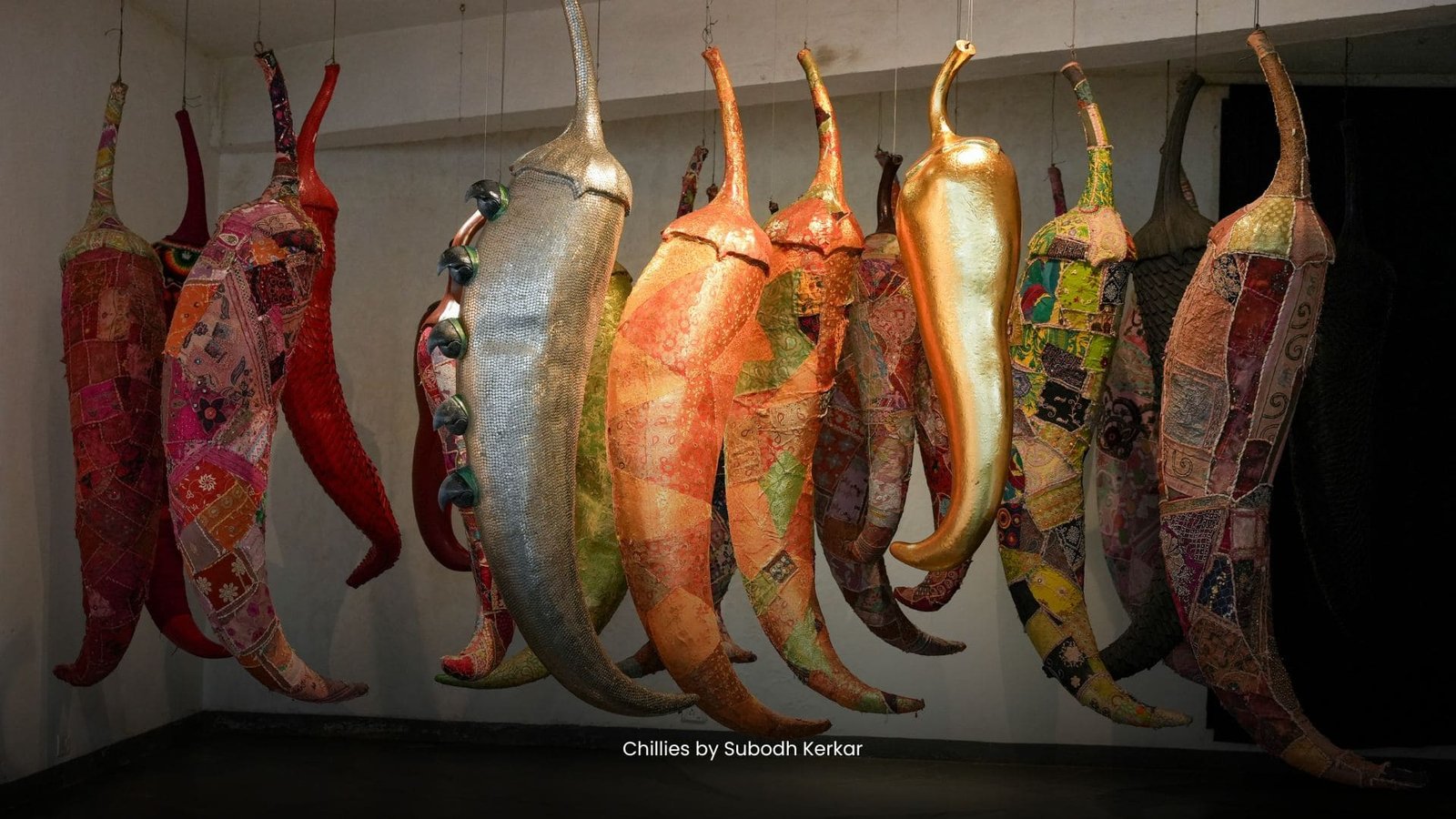
Several works explore the movement of food ingredients and traditions across continents. Pao by Pradeep Naik reflects on the history of breadmaking in Goa and the place of the poder in everyday life. Chillies by Subodh Kerkar considers the introduction of chillies from the Americas and their subsequent place in Indian cuisine. Tea by Sweety Joshi examines the movement of tea through Portuguese and British trade networks, while Kolmer by Pandurang Naik explores the processing of cashew nuts, using laterite stone and porcelain to represent different stages of the process. These works demonstrate how food traditions develop through movement, adaptation, and local practice.
Memory of a Boat — Subodh Kerkar
An old fishing boat, painted in tar and incorporating a flame form made of fibreglass, becomes a tribute to traditional wooden boats used by Goa’s fishing communities. The work recalls boatbuilding techniques, the use of local materials, and the knowledge required to navigate coastal waters. It also reflects on the replacement of wooden boats by fibreglass vessels and the changes this brings to traditional maritime practices.
Iron Ore — Shailesh Dabolkar
This painting uses Chinese tea to depict the remains of a forest being transported across a river. Referring to the environmental consequences of mining in Goa, the work connects the extraction of natural resources with the degradation of the landscape. Its use of tea as a medium also links environmental concerns with the wider histories of material exchange explored throughout the exhibition.
Mussel Shell Ocean — Subodh Kerkar
Mussel shells arranged along an installation measuring over 31 feet evoke the movement and changing colours of ocean waves. The work reflects on the sea as both a force that shapes Goa’s landscape and a medium that connects distant regions. It invites visitors to consider the ocean’s influence on local lifestyles, cultural practices, and histories of exchange.
Learning & Engagement
Histories of Goa encourages visitors to approach artworks as starting points for historical inquiry. By observing the materials, forms, and subjects of individual works, visitors can explore how artists interpret historical events and connect them with contemporary concerns.
The exhibition also provides opportunities to reflect on the histories embedded in familiar objects and practices. Food, boats, religious symbols, textiles, and everyday materials can reveal connections to distant places, changing technologies, and social relationships. Visitors are invited to consider how these objects acquire meaning and how their histories influence present-day identities and practices.
Credits
Institution: Museum of Goa (MOG)
Artists: Over 20 local and national artists, including those listed in this exhibition text.
Practical Information
Exhibition: Histories of Goa
Status: Ongoing exhibition; the selection of works and materials changes periodically.