
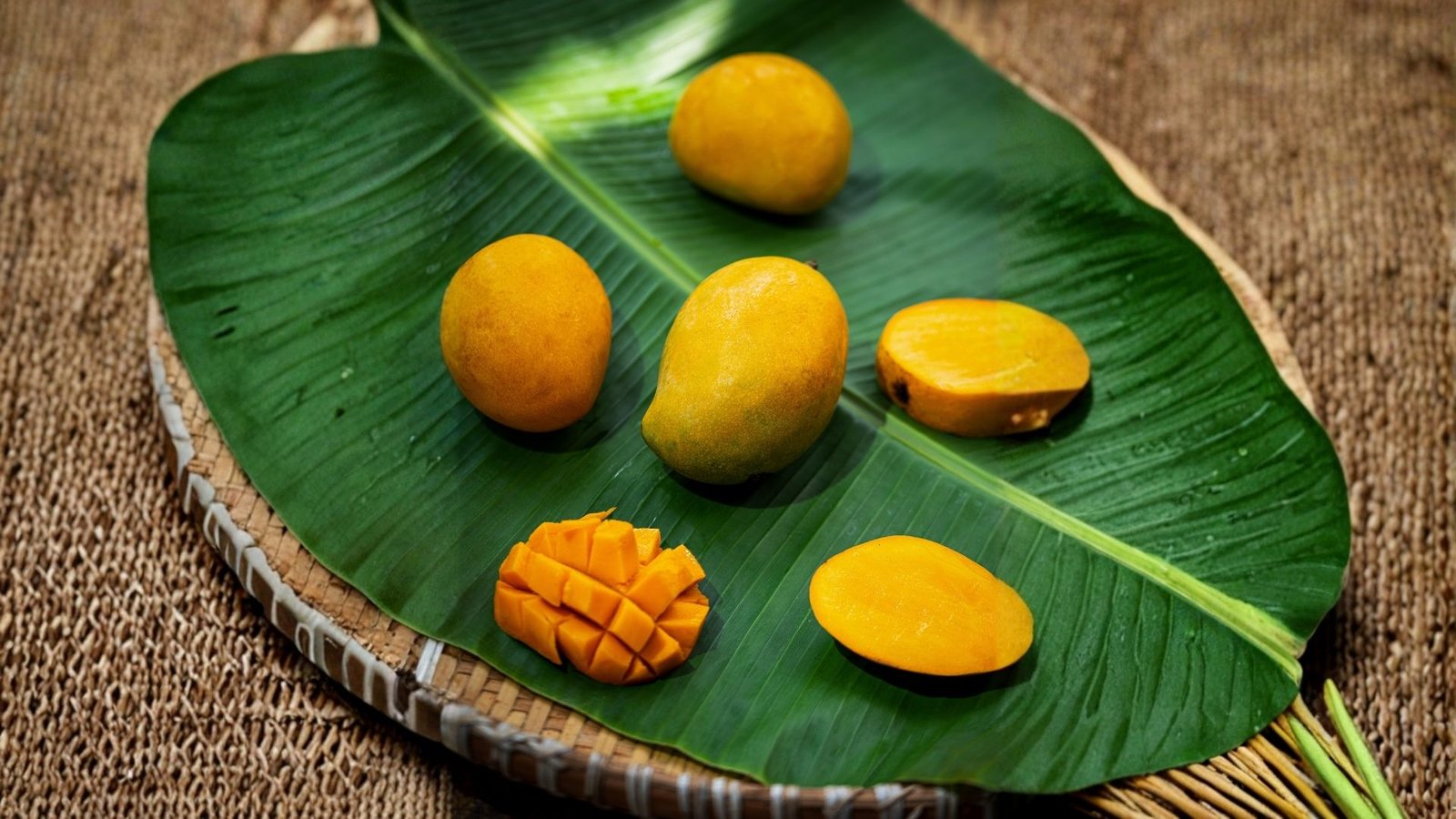
Mango begins with a memory. The quiet excitement of cutting or simply biting into a ripe mango. The air is heavy with heat, the sweetness almost excessive. Something you wait for all year. Before the fruit was named, before it travelled across regions, the mango existed in the subcontinent, its seeds pressed into the ancient soil. Botanical evidence points to its origin in the Indo-Burmese region, where it first took root and was domesticated.
Long before empires formed and adored mango, it bloomed and spread quietly. Its taste travelled before its name did. The word mango is traced to the Dravidian languages- māṅṅa (മാങ്ങ) in Malayalam, māṅkāy (மாங்காய்) for the raw fruit, and māmpaḻam (மாம்பழம்) for the ripe in Tamil. The Portuguese, encountering it on the western coast of India, carried the word outward and popularised it.
In Sanskrit, mango is amra, later rasala, names that do not merely identify, but evoke sensation, sweetness and fullness. Travellers noticed it too, in the 7th century, Xuanzang, moving along the Ganges River, wrote of abundant, shaded mango groves lining its banks. In myths, the mango takes on another identity, becoming a symbol of fertility, desire, and protection. Under its branches sits Ambika (Jain Yakshini), fertility held in posture. In sculpted stone at Sanchi Stupa, the tree is not only a tree; it is protection, presence and a form that shelters both body and belief. Mango finds its way into desire too. Kamadeva carries arrows tipped with mango blossoms called the Mohanam associated with infatuation and enchantment.
By the time the mango entered the courts of kings, it had already lived many lives. Through the Baburnama, we understand that Babur, shaped by the orchards of Central Asia, found little delight in the unfamiliar mango; yet in time, the later Mughals embraced it with admiration, transforming what was once dismissed into a fruit of imperial taste and belonging. In the orchards of Akbar, thousands of mango trees were planted with the intention of cultivation. Under Shah Jahan, it travelled across distances, from the Konkan coast to imperial kitchens, its sweetness preserved through movement.
Painters began to notice mangoes. In the miniature paintings from Awadh and Lucknow, mangoes appear quietly in the background of gardens or in the hands of figures. Somewhere along this long history, its curve begins to detach from its body. It becomes a form repeated, stylised, abstracted, visible through the patterns like ambi and mankalam. It is woven into Kashmiri shawls, dyed into Bandhani, painted in Kalamkari, embroidered in chikankari, shaped in gold as the manga malai. It is even drawn on floors as Aipan and Mandana. It travels beyond the subcontinent, renamed and recontextualised, becoming paisley in distant markets.
Writers also returned to mango. Kalidasa writes of its blossoms as part of the changing season. Mirza Ghalib calls it God-sent, with affection that borders on devotion. Tagore lingers on its flowers, the aamer manjori, capturing something fleeting, something that exists only for a moment before becoming fruit.
Even now, it continues to diversify. Alphonso mango, named after Afonso de Albuquerque, reflects a history of encounters in Goa. Dasheri, Kesar, Kohitoor, Noor Jahan, Imam Pasand, each with its own geography and cultivation pattern. Each one a variation on a form that has never stayed still. Even the winds carry its presence. Mango showers, a colloquial term for pre-monsoon rainfall between March and May, mark the seasonal cycle tied closely to its flowering and fruiting.
The mango has travelled across time not just as fruit, but as idea, symbol, and pattern. What seems simple is layered, shaped by soil, empire, craft, and memory. It does not belong to a single narrative. It lingers instead in orchards, in paintings, in textiles, in language.
In the curve of a motif.
In the taste of summer.
In the memory of something that returns, year after year.
Authored by P S Soorya | Museum Associate | Museum of Goa
References
- Nast, C. (2021, May 23). Mangoes as seen in Indian miniature paintings.Architectural Digest India.
- iamanoushkajain. (2025, May 18). India’s Golden Obsession – Mangoes in Memory, Culture and Cuisine – Enroute Indian History India’s Eternal Love for Mangoes: History, Art, and Aamras. Enroute Indian History.
- Pillai, S. C., K., S., & Palani, N. (2023, April 13). Mango ( Mangifera indica L.) Leaves Bring Together the Cultural Values and Scientific Heritage of the Indians for Centuries. Social Science Research Network. https://doi.org/10.2139/ssrn.4417613
- mapteam. (2023, July 17). A Sticky Reputation: South Asia Through Mangoes Then and Now – Impart. Impart.
- Brittany. (2025, July 13). The Mango and the Map of Language. An American in Kerala.
- India, T. O. (2009, May 30). What are mango showers? The Times of India; Times Of India.
- Smithsonian’s National Museum of Asian Art. (2020, March 25). Food for thought: melons,mangoes,and mughals.